
Artificial intelligence is moving beyond systems that simply answer questions.
A new category of AI tools, commonly called AI agents, can understand a goal, decide what steps are required, use connected tools, and take actions with limited human guidance.
Instead of only telling you how to complete a task, an AI agent may be able to complete parts of that task for you.
But what exactly is an AI agent, how does it work, and how is it different from a chatbot?
What Is an AI Agent?
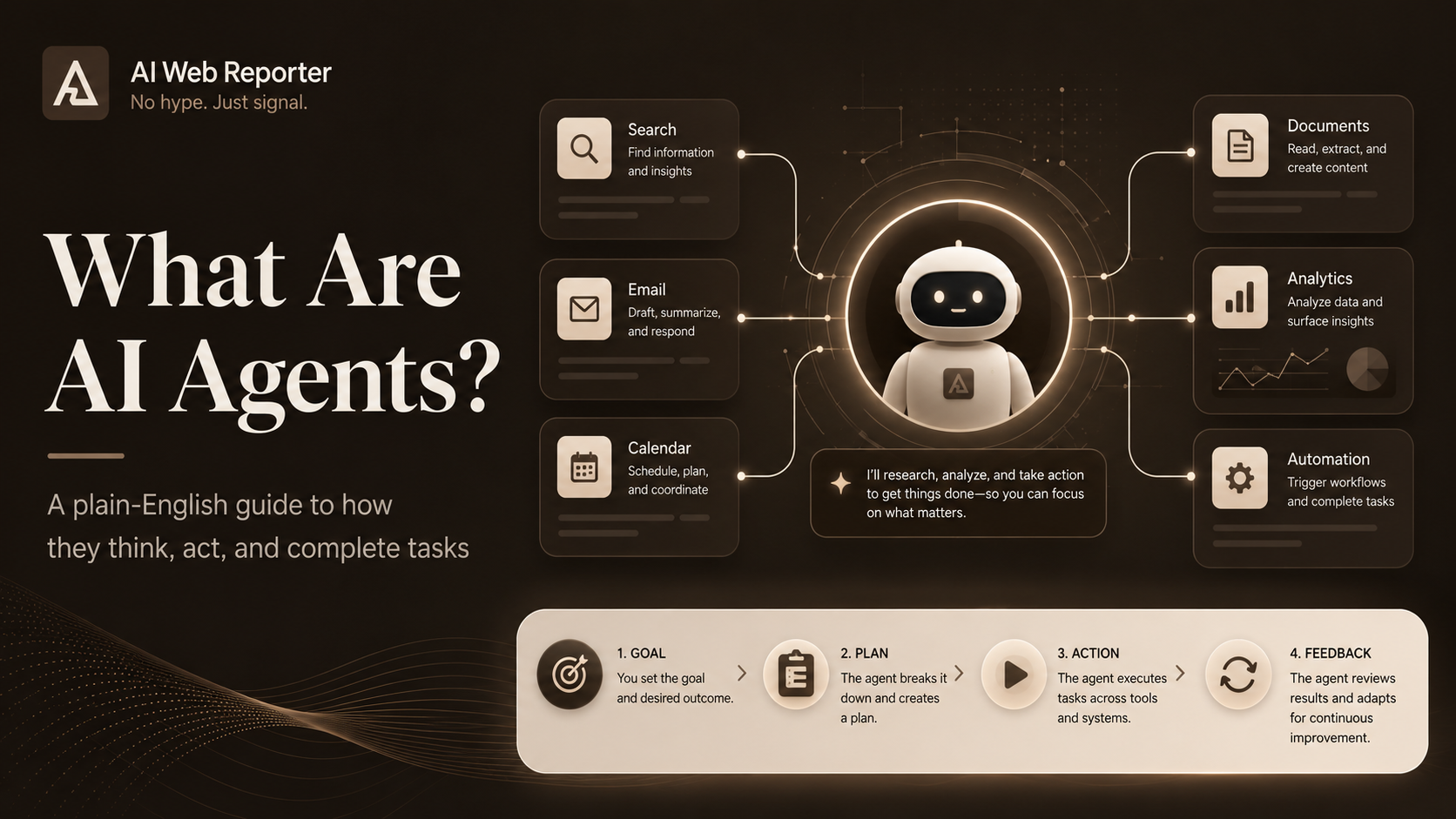
An AI agent is a software system designed to achieve a specific goal by processing information, making decisions, using available tools, and taking actions.
In simple terms, an AI agent follows a process like this:
Goal → Plan → Action → Check results → Continue or stop
For example, imagine asking an AI system to:
Find three suitable hotels for a business trip, compare their prices and prepare a summary.
A standard chatbot may explain how to search for hotels.
An AI agent could potentially:
- Search available hotel information
- Compare prices and locations
- Apply your preferences
- Organise the findings
- Present a final recommendation
More advanced agents may also connect with calendars, databases, email systems, websites, or business software.
Google Cloud defines an AI agent as an application that achieves a goal by reasoning with available information and tools, then taking actions based on its decisions.
How Do AI Agents Work?
Most AI agents combine several important components.
1. A goal or instruction
The user gives the agent an objective.
For example:
Review these customer complaints and identify the most urgent cases.
The instruction defines what the agent is expected to achieve.
2. An AI model
A large language model acts as the reasoning engine.
It interprets the request, analyses information, and decides what to do next.
3. Tools
Tools allow the agent to interact with other systems.
These may include:
- Web search
- Calendars
- Databases
- Customer relationship management systems
- Code execution
- Document storage
- Business applications
Without tools, an AI model can mainly generate information. With tools, an agent may also perform actions.
4. Memory or context
An agent may keep track of previous steps, user preferences, or relevant information.
This helps it avoid starting from the beginning after every action.
5. A feedback loop
After taking an action, the agent checks the result.
It may then:
- Continue to the next step
- Correct an error
- Try a different approach
- Ask the user for clarification
- Stop when the goal is complete
Anthropic describes effective agents as systems that operate across multiple steps, use tools, and assess results from their environment before deciding what to do next.
AI Agents vs Chatbots

AI agents and chatbots are related, but they are not the same.
| Chatbot | AI agent |
|---|---|
| Primarily answers questions | Works toward a defined goal |
| Usually responds one message at a time | Can complete multiple connected steps |
| Often waits for the next instruction | May decide what action is needed next |
| Mainly produces text | Can use tools and interact with systems |
| Usually provides guidance | May perform parts of the task |
A chatbot may tell you how to organise a meeting.
An AI agent may check calendars, identify suitable times, prepare an invitation and ask for approval before sending it.
However, the line between assistants, chatbots, and agents is becoming less clear as more AI products gain tool-use and task-completion capabilities.
Real-World Examples of AI Agents
AI agents can be used in many industries and workflows.
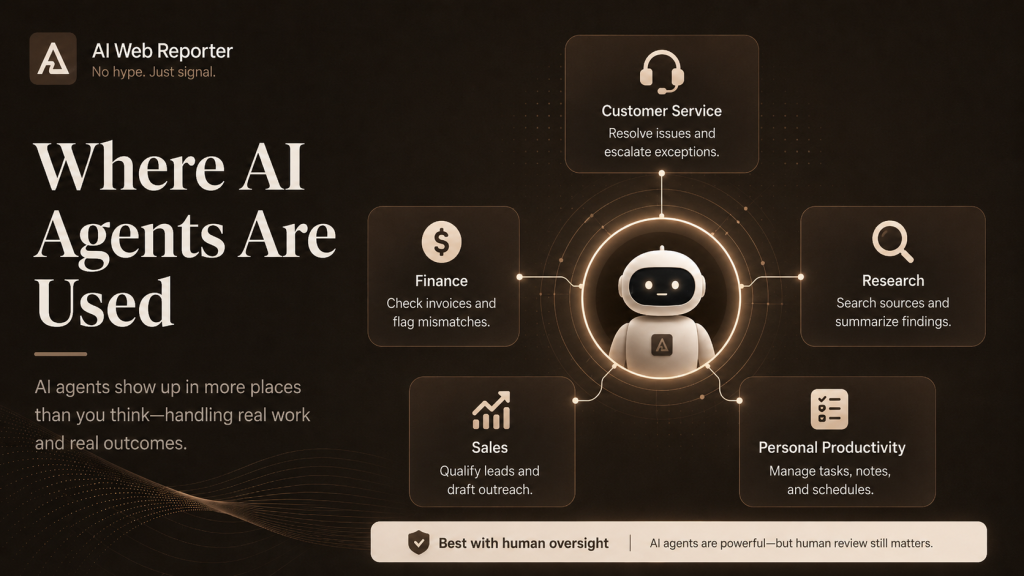
Customer service
An AI agent may:
- Read a customer message
- Identify the issue
- Check order or account details
- Suggest a solution
- Escalate complex cases to a human
Sales
A sales agent may:
- Review incoming leads
- Research companies
- Score prospects
- Draft personalised outreach
- Update a CRM system
Finance
A finance agent may:
- Extract information from invoices
- Compare invoices with purchase orders
- Identify mismatches
- Route exceptions for approval
- Prepare records for posting
Research
A research agent may:
- Search multiple sources
- Compare findings
- Extract important facts
- Organise references
- Produce a structured summary
Software development
A coding agent may:
- Read a task
- Inspect a codebase
- Write or modify code
- Run tests
- Detect errors
- Revise its work
Personal productivity
A personal AI agent may help with:
- Calendar planning
- Email organisation
- Travel research
- Task management
- Document preparation
What Are Agentic Workflows?
Not every system called an AI agent is fully autonomous.
Some systems follow predefined steps. These are often described as agentic workflows.
For example:
- Extract information from a document
- Validate the information
- Send it for approval
- Record the final decision
The order is mostly fixed.
A more autonomous agent has greater freedom to decide which steps to take and which tools to use.
Anthropic recommends using the simplest architecture that can reliably complete the task. In many situations, a structured workflow may be safer and easier to control than a highly autonomous agent.
Why Do AI Agents Matter?
AI agents may change how people interact with software.
Traditional software requires users to open applications, navigate menus, and complete each action manually.
With an AI agent, a user may simply describe the desired outcome.
For example:
Prepare a weekly sales report and highlight the three largest risks.
The agent could collect information, analyse it, and create the report.
This could help organisations:
- Reduce repetitive manual work
- Complete routine tasks faster
- Connect information across systems
- Improve response times
- Support employees with complex workflows
- Allow staff to focus on higher-value work
The major shift is from asking AI for information to delegating goals to AI systems.
Risks and Limitations of AI Agents
AI agents are promising, but they are not automatically reliable.
Incorrect decisions
An agent may misunderstand a request or reach the wrong conclusion.
When an agent can take actions, an incorrect answer may become an incorrect action.
Hallucinated information
AI models can generate information that sounds accurate but is false.
Agents should be connected to reliable data sources and required to verify important information.
Excessive permissions
An agent with access to email, financial systems, or customer data may create a serious risk if its permissions are too broad.
Access should follow the principle of least privilege.
Privacy and security
Agents may process sensitive company or personal information.
Organisations must control:
- What data can an agent access
- Where information is stored
- Which actions can it perform
- Who can review its activity
Unpredictable behaviour
Highly autonomous systems may take unexpected routes to complete a task.
This makes monitoring and evaluation essential.
Lack of human judgment
AI agents may struggle with emotional sensitivity, ethical trade-offs, ambiguous situations, and complex social decisions.
Google Cloud notes that AI agents can struggle with tasks requiring deep empathy or nuanced human interaction.
How Can AI Agents Be Used Safely?
A reliable AI agent should include clear controls.
Important safeguards include:
Human approval
High-impact actions should require confirmation.
Examples include:
- Sending payments
- Deleting files
- Publishing public content
- Changing customer records
- Sending external emails
Limited access
The agent should receive only the permissions required for its task.
Trusted data
Where possible, the agent should use verified company data or trusted external sources.
Activity logs
Every important action should be recorded for review.
Testing and evaluation
Agents should be tested using realistic scenarios before being used in production.
Clear stopping rules
The agent should know when to stop, request help, or escalate to a human.
OpenAI recommends combining models and tools with clear instructions and adding guardrails to keep agent behaviour within the intended scope.
Will AI Agents Replace Human Workers?
AI agents are more likely to change tasks before they replace entire professions.
Many jobs contain a mixture of:
- Repetitive tasks
- Administrative work
- Decision-making
- Communication
- Creativity
- Relationship management
- Human accountability
Agents may handle some routine steps, while people remain responsible for judgment, strategy, approval, and sensitive interactions.
The most realistic near-term model is human-agent collaboration.
People define the goals, supervise the system, and handle important exceptions. Agents assist with research, coordination, analysis, and execution.
What Happens Next?
AI agents are likely to become a more common part of business software and everyday productivity tools.
We can expect:
- More AI systems connected to workplace applications
- Greater use of agents for multi-step tasks
- Stronger security and approval controls
- More specialised agents for individual industries
- Increased focus on testing and monitoring
- More collaboration between humans and multiple AI agents
The key question will not simply be whether an AI system can take action.
It will be whether it can take the correct action reliably, securely, and transparently.
Final Takeaway
AI agents are systems that can work toward goals, use tools, and complete multi-step tasks.
They represent an important shift from AI that mainly generates answers to AI that can also perform actions.
Their potential is significant, but so are the risks.
The most effective AI agents will not be the ones given unlimited freedom. They will be the ones built with clear goals, reliable data, limited permissions, strong oversight, and human approval where it matters.
What task would you trust an AI agent to handle for you?
Visit AI Web Reporter for clear AI news, practical explainers, and useful AI tool coverage.
Stay Ahead of AI
AI is moving from answering questions to completing real tasks.
Follow AI Web Reporter for clear AI news, practical explainers, and useful AI tool coverage.
No hype. Just signal.