


Artificial intelligence is becoming an important part of the national infrastructure.
Governments increasingly view AI as more than a software service purchased from an international provider. They see it as a strategic capability connected to economic growth, public services, national security, language, culture and control over data.
This shift has increased interest in sovereign AI.
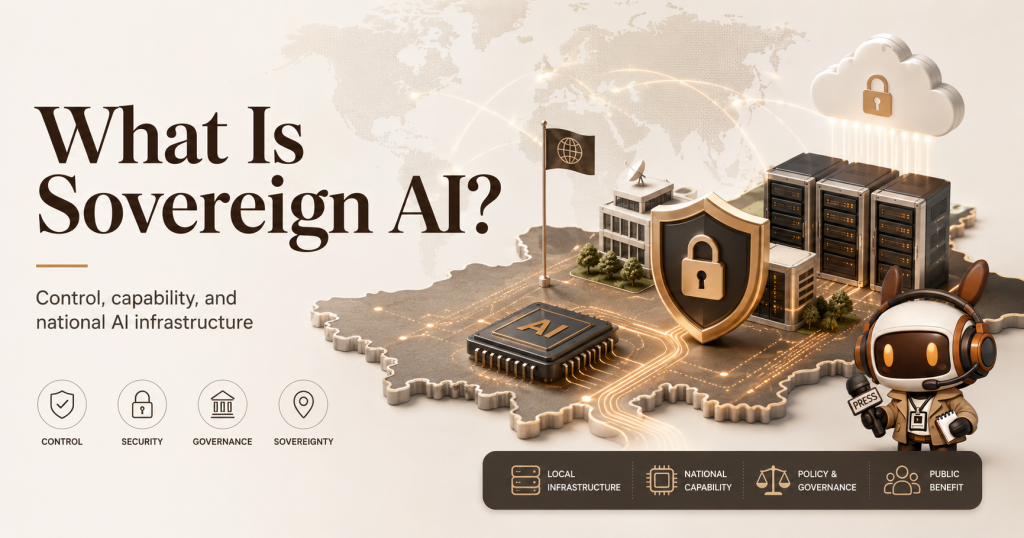
Sovereign AI refers to a country’s ability to develop, operate and govern artificial intelligence using its own infrastructure, data, workforce and legal framework.
It does not always mean that every component must be built locally. It means that a country or organisation maintains meaningful control over how its AI systems are trained, deployed, managed and protected.
What is sovereign AI?
Sovereign AI is the ability of a nation to develop artificial intelligence using infrastructure, data, models, talent and governance that reflect its own priorities.
A sovereign AI strategy may include local data centres, national cloud platforms, language models, research institutions and regulatory controls.
The goal is to reduce complete dependence on foreign providers while building local expertise and economic value.
For example, a country may use international hardware but operate it inside local data centres under national laws.
It may also train models on local languages, public records, scientific information and industry data.
Sovereign AI is therefore mainly about control, capability and accountability.
Why countries want greater control over AI
Countries depend on AI for a growing number of services.
These may include:
- Healthcare
- Education
- Public administration
- Defence
- Transportation
- Energy
- Financial services
- Cybersecurity
- Scientific research
If these systems depend entirely on external providers, governments may have limited control over availability, pricing, data processing and policy changes.
A provider could change its terms, restrict access or move data across jurisdictions.
Countries also want to protect sensitive information.
National datasets may include citizen records, medical information, government documents or critical-infrastructure data.
Keeping this information under local legal and technical control can reduce some privacy and security risks.
The main components of sovereign AI
Sovereign AI requires more than a single data centre or language model.
A complete strategy usually includes several connected components.
Local computing infrastructure
Countries need access to GPUs, servers, networking, storage, energy and cooling systems.
These resources support model training and inference.
National or approved data
AI systems need relevant and legally usable data.
This may include local languages, cultural information, scientific research and industry-specific datasets.
Skilled professionals
Engineers, researchers, cybersecurity specialists and policy experts are needed to build and manage AI systems.
Governance and regulation
Clear rules are required for privacy, safety, accountability and acceptable use.
Locally relevant models
Models should understand national languages, services, industries and cultural context.
Secure cloud and deployment systems
Governments and businesses need controlled environments for running AI workloads.
These components must work together.
Hardware without data and skills will not create a sustainable sovereign AI ecosystem.

Why data residency and local infrastructure matter
Data residency refers to the location where information is stored and processed.
Some governments and regulated industries require sensitive data to remain within a specific country or approved region.
Local infrastructure can help organisations meet these requirements.
It may also provide greater control over:
- User access
- Encryption
- System monitoring
- Data retention
- Legal compliance
- Service continuity
Microsoft’s Sovereign Cloud offering, for example, highlights controls related to data residency, sovereign AI processing, limited operator access and business continuity.
However, local infrastructure does not automatically guarantee security.
Systems still require strong governance, skilled teams, regular testing and clear accountability.
How sovereign AI supports local languages and industries
Many global AI models are strongest in widely used languages with large digital datasets.
Smaller languages may receive less accurate or less culturally appropriate support.
Sovereign AI programmes can invest in language data and local model development.
This may improve AI services for education, public administration, healthcare and local businesses.
Local models can also support important industries.
A country with a strong manufacturing sector may develop AI for industrial automation.
An agricultural economy may focus on crop monitoring, weather analysis and supply-chain planning.
A country exposed to natural disasters may use AI for forecasting and emergency response.
NVIDIA has described sovereign AI initiatives that support local language development, workforce training and national applications such as climate resilience and disaster response.
Benefits of sovereign AI
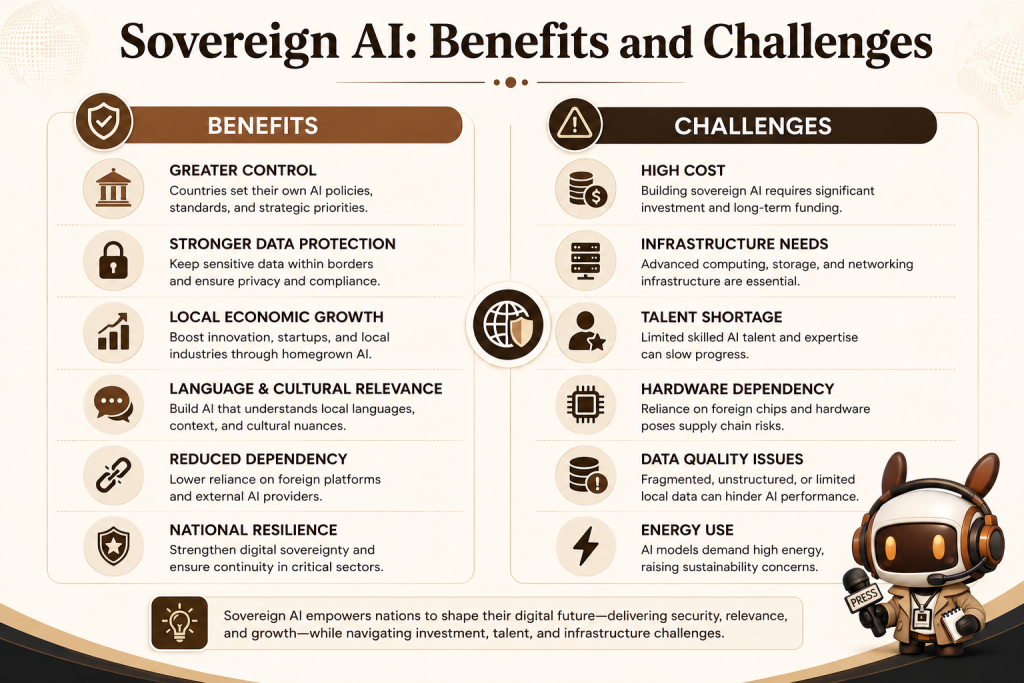
Sovereign AI can provide several potential benefits.
Greater control
Governments and organisations can define how data, models and infrastructure are managed.
Stronger data protection
Sensitive information can remain within approved environments.
Local economic growth
Investment may create jobs for engineers, researchers, data-centre operators and technology providers.
Language and cultural relevance
AI systems can be trained for local languages and public needs.
Reduced dependency
Countries may be less exposed to changes made by foreign technology providers.
National resilience
Local AI infrastructure can support public services and critical systems during disruption.
These benefits explain why sovereign AI has become a strategic priority in many regions.
Challenges and limitations
Building sovereign AI is expensive.
Large-scale AI infrastructure requires advanced chips, energy, networking, cooling and skilled professionals.
Countries may still depend on international suppliers for important hardware and software.
Talent is another challenge.
Experienced AI researchers, infrastructure engineers and cybersecurity specialists are limited in number.
Data quality can also be difficult.
A country may have large datasets, but those datasets may be fragmented, outdated or legally restricted.
Sovereign AI can also create duplication.
Multiple countries building similar infrastructure may increase costs and energy use.
There is also a risk that sovereignty becomes an excuse for isolation or excessive control.
Strong systems should support national priorities without blocking international research, safety cooperation and technical standards.
Examples of sovereign AI investment
Several countries are investing in local AI infrastructure.
NVIDIA and SK Telecom have announced plans to build a sovereign AI cloud infrastructure in Korea.
NVIDIA and NAVER are also expanding AI factory infrastructure intended to support Korean companies, developers and industries.
These projects combine computing platforms, cloud services and local industry capabilities.
The United Kingdom is also investing in sovereign AI infrastructure and national computing capacity.
Other countries are developing national language models, public-sector AI platforms and local cloud environments.
The specific approach differs by country, but the objective is similar: maintain more control over strategic AI capability.
What businesses should understand?
Sovereign AI is not only a government issue.
Businesses may face new requirements related to data location, cloud providers and AI processing.
A company operating across several countries may need different deployment options for different regions.
Regulated industries may prefer AI systems that provide:
- Local data storage
- Clear access controls
- Audit logs
- Regional model hosting
- Business continuity
- Compliance documentation
Technology vendors may need to offer flexible architecture rather than one global deployment model.
Companies should ask where their data is stored, who can access it and which laws apply.
They should also understand how easily they can move workloads between providers.
What happens next?
Sovereign AI investment is likely to continue growing.
Countries will build more AI factories, national cloud platforms, language models and workforce programmes.
Partnerships with global technology companies will remain important because few countries can build every component alone.
The key question will be how much control a country can maintain while still benefiting from international technology and research.
The most successful sovereign AI strategies may combine local ownership with global cooperation.
They will need reliable infrastructure, skilled professionals, strong governance and clear public value.
Sovereign AI is not simply about owning servers.
It is about building the capability to use artificial intelligence in a way that reflects national laws, languages, economic goals and public priorities.
Do you think sovereign AI will improve national resilience, or could it create a more fragmented global technology ecosystem?
Official sources
NVIDIA’s explanation of sovereign AI
Microsoft Sovereign Cloud
NVIDIA and SK Telecom’s sovereign AI infrastructure