
Artificial intelligence is becoming a common tool for people trying to understand health and wellness information.
Users may ask ChatGPT to explain medical terms, summarize laboratory results, prepare questions for an appointment, or organize information about symptoms and lifestyle habits.
OpenAI has announced improvements to health intelligence in ChatGPT, with a focus on clearer communication, better context, more appropriate uncertainty,y and stronger recognition of situations that may require urgent care.
These improvements may make health information easier to understand. However, users must still know what artificial intelligence can and cannot safely do.

What is ChatGPT health intelligence?
ChatGPT health intelligence refers to the model’s ability to understand health-related questions and provide clear, structured, and context-aware responses.
A useful health response should do more than provide a quick answer.
It should recognize when information is missing, explain uncertainty, identify possible warning signs, and encourage the user to seek professional care when appropriate.
OpenAI says its latest health improvements were shaped by model development and physician-led evaluation.
The company works with medical professionals who review sample responses, identify weaknesses, and define what a safer and more useful answer should look like.
This process is intended to improve accuracy, communication, completeness, caution, and appropriate escalation.
How ChatGPT health intelligence may help users
ChatGPT may help users understand complicated medical language in simpler terms.
For example, a person may use it to:
- Prepare questions before a medical appointment
- Summarize a medical document
- Understand common health terminology
- Organize a list of symptoms
- Review general wellness information
- Compare questions to discuss with a clinician
- Understand the purpose of a laboratory test
This can help users feel more prepared when speaking with a doctor or other healthcare professional.
It may also reduce confusion when information is spread across reports, portals, notes, and wellness applications.
However, the quality of an answer depends on the information provided by the user and the limitations of the AI system.
Why context matters in health questions
Health questions are rarely simple.
The meaning of a symptom may depend on age, medical history, medication use, pregnancy, recent procedures, duration, severity,y and other factors.
An AI system that does not have enough context may provide an answer that is too general or inappropriate for the situation.
A responsible response should ask for relevant information instead of making an immediate assumption.
It should also avoid presenting uncertainty as certainty.
For example, two people may describe similar pain but have very different causes and risks.
That is why health-related AI should support understanding rather than make final medical decisions.
AI should not replace diagnosis or treatment.
ChatGPT Health is designed to support people in understanding health information and preparing for medical conversations.
It is not intended to replace professional diagnosis, treatment, or emergency care.
AI systems can make mistakes.
They may misunderstand information, miss an important detail, or provide an answer that does not match the user’s personal situation.
Users should not stop medication, begin treatment,t or delay urgent care based only on an AI-generated response.
Decisions involving diagnosis, medication, surgery, pregnancy, mental health emergencies, or severe symptoms require qualified professional guidance.
Recognizing urgent situations
One important area of health intelligence is identifying when a user may need immediate medical attention.
A useful response should not attempt to manage a possible emergency through general advice.
It should encourage urgent medical evaluation when a situation includes serious warning signs.
Examples may include severe breathing difficulty, sudden weakness, loss of consciousness, major bleeding, or rapidly worsening symptoms.
AI can help remind users that urgency matters, but it cannot physically examine the person or confirm the cause.
When symptoms appear serious, seeking local emergency care is more important than continuing an online conversation.
The role of physicians in improving responses
OpenAI says physicians help evaluate health responses across realistic situations.
They review whether answers are accurate, understandable, complete, and appropriately cautious.
They also identify situations where the model should ask more questions, communicate uncertainty more clearly, or recommend professional care sooner.
Physician involvement is important because health communication is not only about factual information.
A response must also consider safety, local healthcare context, user understanding, and the risk of advising with too much confidence.
Medical evaluation helps developers identify where the system performs well and where further improvement is needed.
Privacy and personal health information
Health information is highly sensitive.
Users should think carefully before sharing personal medical records, identification details, or private information with any online service.
ChatGPT Health has been introduced as a separate health-focused experience with additional privacy and security protections.
OpenAI says health conversations are kept in a dedicated space and are not used to train its foundation models.
Users may also be able to connect medical records or wellness applications with permission.
Before connecting any service, users should review what information will be shared, how access can be removed, and which third party may process the data.
Privacy controls are an important part of responsible digital health use.

What users should do before acting on AI health information
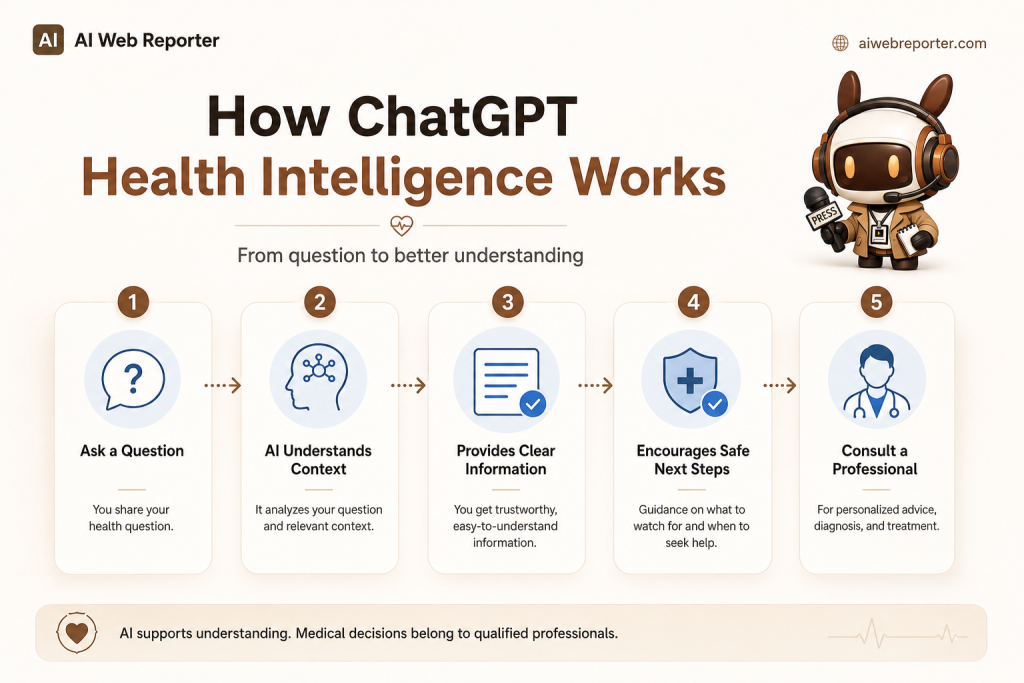
Before using any AI-generated health answer, users should follow a simple safety process.
First, check whether the response clearly explains uncertainty.
Second, verify important claims using trusted medical sources.
Third, consider whether the answer reflects personal medical history and current symptoms.
Fourth, write down questions to discuss with a healthcare professional.
Fifth, seek urgent care when serious warning signs are present.
AI is most useful when it helps people become better informed and better prepared.
It becomes risky when users treat a general response as a confirmed medical decision.
What happens next?
Health-related artificial intelligence will likely become more useful as models improve and more healthcare tools become connected.
Future systems may help users organize records, prepare for appointments, understand trends, and communicate more clearly with clinicians.
The most important challenge will be maintaining trust.
Health AI must communicate uncertainty, protect sensitive information, encourage professional care, and avoid overstating what it knows.
Better performance does not remove the need for human medical judgment.
The strongest future health systems will combine useful AI support with qualified professional care, clear privacy controls, and responsible user decisions.
Would you trust artificial intelligence to help explain your health information, or would you prefer to rely only on a healthcare professional?
Official sources
OpenAI health intelligence announcement
Introducing ChatGPT Health