

Stay Informed with AI Web Reporter
Clear AI news, practical updates, and trusted analysis.
No hype. Just signal.
AI Financial Advice Regulation: Why Regulators Are Paying Attention
Artificial intelligence is moving deeper into finance.
Not just in banking apps.
Not just in trading dashboards.
Not just in customer support.
AI tools are now being used by ordinary people to ask questions about savings, investing, budgeting, pensions, debt, and financial planning.
That shift is creating a new question for regulators:
When an AI model gives financial guidance, is it just information, or is it becoming advice?
That question is now getting serious attention in the United Kingdom. The Financial Conduct Authority has published a landmark review into how AI could reshape retail financial services by 2030 and beyond, while reports say UK regulators are being urged to consider whether large language models such as ChatGPT, Claude, and Gemini should face closer oversight when they influence consumer financial decisions.
This is not just a UK story. It is a signal for every market where AI tools are entering financial products.
What happened?
The UK Financial Conduct Authority published the Mills Review, a major review into the impact of artificial intelligence on retail financial services.
The review looks at how AI may affect consumers, financial firms, markets, and regulators by 2030 and beyond. It also raises questions about how financial regulators should respond as AI becomes more powerful and more widely used.
According to Reuters, FCA executive director Sheldon Mills said Britain should review whether large language models such as ChatGPT, Claude, and Gemini should be regulated as general-purpose AI tools because they are increasingly influencing consumer financial decisions.
That matters because these tools are not traditional financial advisers.
They are general-purpose AI systems.
They can answer almost anything.
They can sound confident.
They can explain complex topics in simple language.
And users may treat that output as advice.
Related: Read more AI news and analysis on AI Web Reporter.
The problem is that regulated financial advice comes with rules, protections, accountability, and standards. General AI responses may not.
Why AI financial advice regulation is becoming important
AI financial advice regulation is becoming important because consumers are already using AI tools to understand money decisions.
A person might ask:
- Should I invest in this stock?
- How much should I save each month?
- Should I pay off debt first or invest?
- Is this pension plan good for me?
- What does this mortgage option mean?
- How risky is this financial product?
These are not small questions.
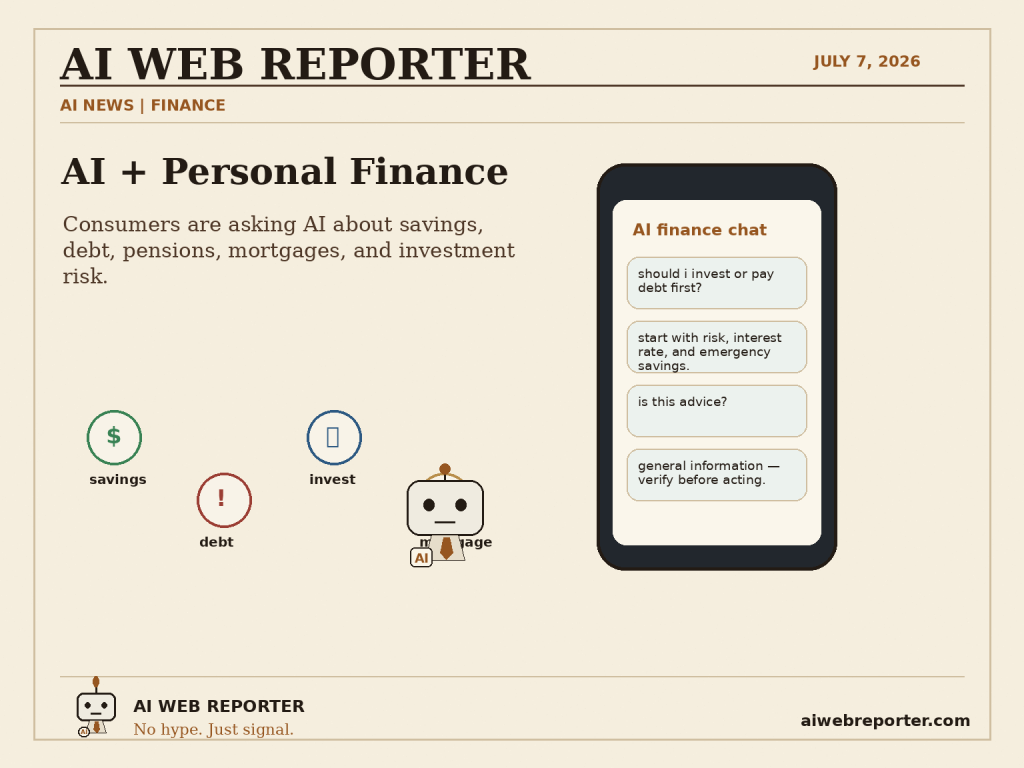
They can affect someone’s savings, debt, retirement, housing, and long-term financial security.
AI tools can make these topics easier to understand. That is the positive side. A clear AI explanation can help people who normally feel excluded from financial knowledge.
But the risk is also obvious.
A model may give an answer that sounds useful but misses important context. It may not know the user’s full financial situation. It may not understand local rules. It may provide generic information that feels personal. It may fail to explain uncertainty clearly.
That is where regulation becomes difficult.
If AI gives a general explanation, it may be harmless.
If AI pushes someone toward a specific financial action, the risk becomes much higher.
The line between information and advice is getting blurry
Financial regulation often depends on the difference between general information and personal advice.
General information might explain what an investment is.
Personal advice may recommend what a specific person should do.
AI makes this line harder to see.

A chatbot can produce a response that feels personal even when it is not truly based on a regulated assessment. It may ask follow-up questions, remember context, compare options, and present a recommendation-style answer.
For many users, that experience may feel like speaking to an adviser.
But the accountability is not the same.
A regulated adviser is expected to follow suitability rules, document reasoning, disclose risks, and operate under regulatory supervision. A general-purpose AI model may not be built for that responsibility.
This is the core regulatory issue.
The user experience is becoming advice-like, even when the legal structure behind it is not.
What regulators are worried about
Regulators are not only worried about one bad answer.
They are worried about scale.
If a human adviser gives poor advice, the damage may affect a limited number of clients. If a widely used AI model gives poor financial guidance, the same pattern could influence thousands or millions of users.
That creates several risks.
1. Consumer harm
Consumers may make financial decisions based on AI-generated responses that are incomplete, outdated, or too confident.
A user may not know whether the AI is giving regulated advice, general information, or a generated answer based on patterns in training data.
2. Overtrust
AI tools can sound polished and authoritative. This can make users trust them more than they should.
The risk is not only that AI may be wrong. The risk is that it may be wrong in a way that sounds convincing.
3. Lack of accountability
If a regulated adviser gives harmful advice, there are complaint routes, documentation, and potential protections.
If a general AI tool gives harmful financial guidance, users may not have the same protection.
4. System-wide dependence
The FCA review also highlights a broader concern: financial firms may become dependent on a small number of technology providers.
If many banks, insurers, fintech firms, and advisers rely on similar AI infrastructure, failures could become more concentrated.
That turns AI from a product feature into a financial system risk.
5. Fraud and manipulation
AI can also make scams more convincing. Fraudsters can use AI to create personalized messages, fake investment explanations, realistic customer support scripts, and automated persuasion systems.
In financial services, trust is everything. AI can strengthen trust, or exploit it.
Why this matters for everyday users
For ordinary users, the message is simple:
AI can help explain finance, but it should not be treated as a guaranteed adviser.
AI can be useful for:
- explaining financial terms
- comparing general product types
- summarizing market news
- preparing questions for a human adviser
- helping users understand risks
- organizing budgets
- learning financial basics
But users should be careful when AI gives:
- investment recommendations
- debt decisions
- pension decisions
- mortgage decisions
- tax guidance
- insurance choices
- high-risk trading ideas
The more personal and high-stakes the decision becomes, the more careful the user should be.
AI can support financial understanding.
It should not replace proper financial responsibility.
What this means for financial firms
For banks, fintech companies, insurers, and wealth platforms, this is a major signal.
AI features cannot simply be added because they look modern.
Firms will need to think about:
- how AI outputs are controlled
- whether the tool gives information or advice
- how risks are disclosed
- how users are warned
- how errors are monitored
- how human oversight is used
- how customer data is protected
- how AI decisions are logged
The more AI becomes part of the financial customer journey, the more compliance teams will need to be involved.
This is where the future of financial AI may become less about flashy features and more about governance.
Europe and the wider AI regulation signal
Although this story is focused on the UK, the wider signal matters for Europe.
Europe is already taking AI governance seriously. Financial services are one of the sectors where mistakes can have direct consumer consequences.
Also read: Latest AI updates for business, finance, and technology.
As AI tools become embedded in finance apps, search tools, investment platforms, and customer support systems, regulators will likely focus on three questions:
- Is the AI giving general information or personalized advice?
- Who is responsible if the AI output causes harm?
- How much transparency does the user get?
These questions will shape how AI financial products are launched, marketed, and monitored.
The opportunity: better access to financial knowledge
The story is not only about risk.
AI could also make financial knowledge more accessible.
Many people do not understand financial products because the language is complex. AI can simplify explanations, translate financial terms, summarize long documents, and help users ask better questions.
That could be valuable.
A well-designed AI tool could help people understand:
- how interest works
- what fees mean
- how risk levels differ
- what inflation does to savings
- how to prepare for financial advice
- what questions to ask before choosing a product
In that sense, AI could improve financial education.
But education and advice are not the same thing.
That distinction may become one of the most important debates in AI finance.
What happens next?
The next phase will likely focus on clearer rules.
Regulators may not ban AI in finance. That is unlikely and unrealistic.

Instead, they may push for:
- clearer disclosure when users are interacting with AI
- stronger rules for AI used in regulated financial products
- more accountability for firms deploying AI
- better consumer warnings
- human review for high-risk use cases
- testing and monitoring of AI outputs
- closer oversight of major technology providers
For AI companies, the message is also clear.
If their tools are influencing financial decisions, regulators may eventually ask whether they should carry more responsibility.
Frequently Asked Questions
What is AI financial advice regulation?
AI financial advice regulation means rules or oversight for AI tools that may influence people’s money decisions, especially when AI-generated answers start to look like personal financial advice.
Why are regulators concerned about AI in finance?
Regulators are concerned because AI tools can sound confident, persuasive, and personal. If users treat AI-generated answers as financial advice, they may make important decisions without the same protection offered by regulated advisers.
Can AI replace a financial adviser?
AI can help explain financial topics, summarize information, and prepare users for better questions. But for high-stakes decisions like investing, pensions, debt, mortgages, tax, or insurance, users should still verify details and speak to a qualified professional.
How should users treat AI-generated financial guidance?
Users should treat AI output as a starting point, not a final decision. AI can help with education and understanding, but important financial choices should be checked against reliable sources, local rules, and professional advice.
Sources
This article is based on official regulatory updates and trusted reporting.
FCA Review Reuters ReportFinal take
AI is entering finance quickly.
That can make financial knowledge easier to access. It can help users understand complex topics. It can make tools more personalized, faster, and more useful.
But finance is not like casual search.
For more clear AI news and practical tech updates, visit AI Web Reporter.
A bad answer can cost real money.
A confident answer can create real risk.
A personalized-sounding answer can blur the line between information and advice.
That is why regulators are paying attention.
The future of AI in finance will not only depend on better models.
It will depend on trust, accountability, transparency, and regulation.