
GPT-5.6 is now generally available, and the biggest story is not simply that OpenAI has released another more capable model.
The more important shift is how the new model family is designed to handle real work.
OpenAI has introduced three GPT-5.6 models called Sol, Terra and Luna, giving users different options based on capability, speed and cost. The company says the family is now available across ChatGPT, Codex and the OpenAI API, with different access levels depending on the product and subscription.
For businesses and professionals, this matters because artificial intelligence is moving beyond answering isolated questions.
The new competition is increasingly about whether AI can understand messy information, work across tools, complete longer tasks and produce something that is actually ready to use.
Here are the seven changes that matter most.
Table of Contents
1. GPT-5.6 Introduces Three Different AI Tiers
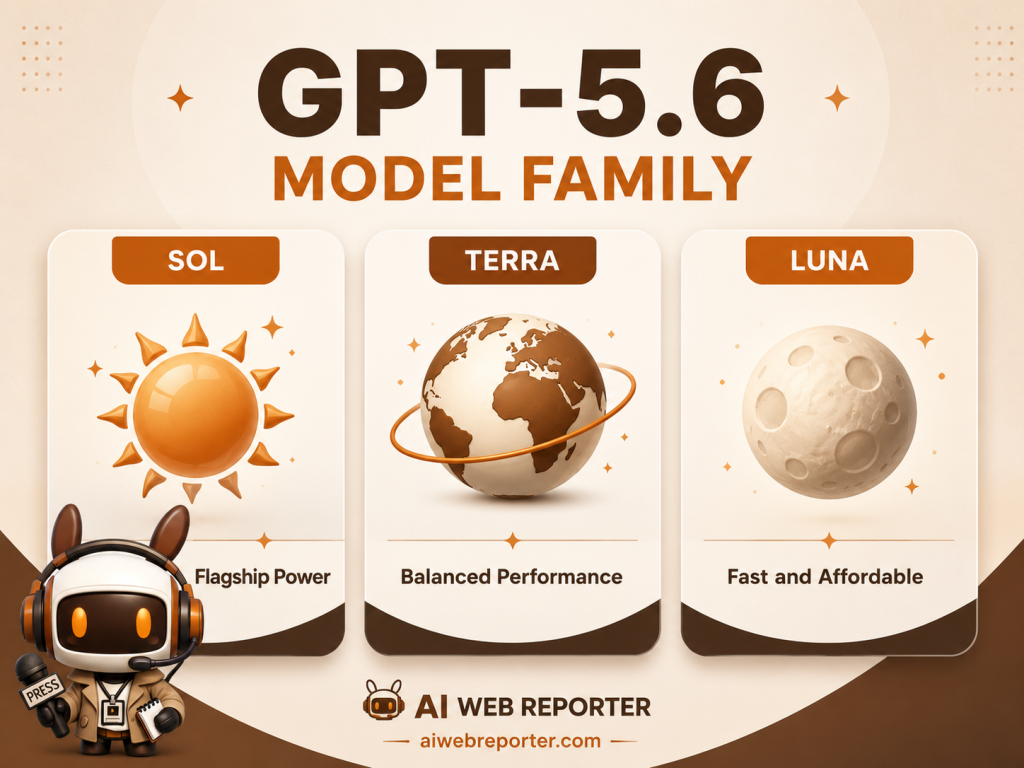
One of the most noticeable changes is that GPT-5.6 is not being presented as a single model for every task.
OpenAI has divided the family into three capability tiers.
Sol
Sol is the flagship model designed for the most demanding work.
OpenAI positions it for complex reasoning, coding, professional knowledge work, computer use, cybersecurity, and scientific tasks.
Terra
Terra is positioned as a more balanced option for everyday professional work.
The idea is to provide strong capability while reducing the cost of using a flagship model for tasks that may not require maximum reasoning.
Luna
Luna is designed to be the fastest and most affordable member of the family.
This structure matters because AI users increasingly need to think about which level of intelligence is actually required for a task.
Using the most powerful model for every email, summary, or routine workflow may not always be the most efficient approach.
The future of business AI may therefore involve smarter model selection rather than simply choosing the most advanced model available.
2. Efficiency Is Becoming as Important as Intelligence
For the past few years, AI companies have competed heavily on benchmark scores and model capability.
With GPT-5.6, OpenAI is placing much greater emphasis on another question:
How much useful work can a model complete for the resources being used?
OpenAI says the new family is designed to get more useful work from each token and improve performance relative to cost. The company also claims that Terra and Luna can provide strong capability at significantly lower cost than larger frontier models in several of its evaluations.
For businesses, this could be more important than a small improvement on a benchmark.
Consider a company running thousands of AI tasks every day.
The difference between an expensive model and a more efficient model can become significant when AI is used for customer support, document processing, research, internal analysis, or software development.
The key question is changing from:
Which AI model is the smartest?
To:
Which model can reliably complete this particular job at the right cost?
That is a much more practical way to evaluate business AI.
3. GPT-5.6 Is Moving Toward Longer End-to-End Work
Perhaps the most important development is the continued shift from AI assistants toward AI systems that can work through longer processes.
OpenAI says GPT-5.6 has been designed for more complex professional workflows involving browsing, tools, computer use, and multiple stages of work. Its highest capability setting can also coordinate parallel workstreams for particularly demanding tasks.

This could change how people think about AI productivity.
Instead of asking an AI tool to:
“Summarise this document.”
A user may increasingly ask it to:
“Review these documents, compare the findings, research missing information, identify the most important issues and prepare a presentation for management.”
The value is no longer only in generating an answer.
This broader shift is also visible in developments such as Mistral’s move into physical AI, where AI systems are being designed to act in the physical world, not just respond in chat.
The value is in connecting multiple steps into a usable outcome.
This is also the direction behind ChatGPT Work, which OpenAI says can gather context, plan an approach and work across files and applications to create documents, spreadsheets and presentations.
For companies, that creates an important opportunity.
It also creates a new responsibility to decide which tasks should be delegated to AI and where human review remains essential.
4. Documents, Presentations and Spreadsheets Are Improving
Generative AI has always been able to produce text.
Producing professional work products is a different challenge.
A useful business document requires structure.
A presentation needs visual hierarchy.
A spreadsheet needs correct logic, formulas and formatting.
OpenAI says GPT-5.6 has improved its ability to create and refine presentations, documents and spreadsheets while following existing templates and design conventions more accurately.
This could be particularly useful for teams that repeatedly create similar materials.
Examples include:
Marketing reports
Financial analysis
Project updates
Research summaries
Client presentations
Operational dashboards
The real productivity gain may come from reducing the time between having information and turning that information into something another person can actually use.
That is a much higher standard than simply generating a block of text.
5. Computer Use Could Change How AI Fits Into Workflows
Another important part of the GPT-5.6 release is stronger computer use.
AI systems are increasingly being designed not only to generate information but also to interact with digital environments.
This means an AI system may potentially inspect what is happening on screen, use tools, and take steps toward completing a task.
OpenAI says GPT-5.6 has improved computer use capabilities and can inspect and refine its own work in some workflows.
This direction is important because many business processes are not contained inside a single chatbot.
Work happens across:
Documents
Browsers
Spreadsheets
Project systems
Internal software
Communication tools
The more effectively an AI system can work across these environments, the more useful it becomes.
But businesses should avoid assuming that greater autonomy means human oversight is no longer required.
The more actions an AI system can take, the more important permissions, approval steps and monitoring become.
6. GPT-5.6 Is Expanding Into Everyday Business Software
The impact of GPT-5.6 will not be limited to people who directly use ChatGPT.
Microsoft announced that the GPT-5.6 family is being integrated into Microsoft 365 Copilot across tools including Word, Excel, PowerPoint, and Copilot experiences. Microsoft also described GPT-5.6 as a preferred model for work across its productivity ecosystem.
This is significant because mainstream AI adoption often happens through software people already use.
A finance team may not think of itself as using a frontier AI model.
It may simply use an AI feature inside Excel.
A marketing team may access the same underlying intelligence through PowerPoint or another productivity platform.
This means model improvements can gradually reach millions of everyday workflows without users actively changing tools.
The larger trend is clear.
AI models are becoming infrastructure underneath ordinary business software.
7. More Capability Makes AI Governance More Important

More powerful AI does not automatically mean every organisation should use every capability immediately.
OpenAI’s safety documentation describes the GPT-5.6 family as a meaningful increase in capability in areas including cybersecurity and explains that additional safeguards were implemented before wider deployment.
For ordinary businesses, the practical lesson is broader.
As AI becomes capable of handling longer tasks and taking more actions, companies need clearer rules around its use.
European businesses should also understand the wider regulatory landscape outlined in our guide to AI regulation in Europe in 2026.
Questions worth asking include:
Who is responsible for reviewing important AI outputs?
What information is the AI allowed to access?
Which actions require human approval?
How are mistakes identified?
Which tasks should never be fully automated?
How is confidential information protected?
The companies that benefit most from advanced AI may not be those that simply adopt it fastest.
They may be the organisations that understand where AI creates genuine value and build appropriate controls around it.
What GPT-5.6 Means for Everyday AI Users
For an average user, the release may not immediately feel like a completely different category of technology.
The changes are likely to appear gradually.
AI may require less detailed prompting.
Complex tasks may need fewer corrections.
Documents may look more polished.
Research workflows may involve fewer manual steps.
Different models may be selected automatically depending on the task.
The biggest change could therefore be less visible than a new chatbot interface.
AI is becoming more capable of moving from a request to a finished piece of work.
That is an important transition.
What Businesses Should Do Next
Businesses do not need to replace every existing AI workflow because a new model has launched.
A better approach is to test where the new capabilities actually produce measurable improvements.
Start with one real workflow.
Compare the output with the system you currently use.
Measure:
Time saved
Quality of the final result
Number of corrections required
Cost
Reliability
Human review required
The goal should not be to use GPT-5.6 everywhere.
The goal should be to identify where it creates better outcomes.
That approach also prevents organisations from turning every AI announcement into an expensive technology experiment.
The Bigger Picture
Frequently Asked Questions About GPT-5.6
Quick answers to the most important questions about GPT-5.6 and its potential impact on everyday AI work.