

Artificial intelligence is now part of everyday business.
Companies use AI to write emails, create marketing content, answer customer questions, screen applications, analyse documents, qualify leads and support business decisions.
But in Europe, using AI is no longer only a technology decision.
It is also becoming a compliance decision.
AI regulation in Europe in 2026 is entering an important implementation stage as major parts of the EU AI Act begin to apply. The rules do not ban ordinary AI use. Instead, they use a risk-based approach: the more an AI system can affect people’s safety, rights or opportunities, the stronger the obligations become.
For most small businesses, the first step is not hiring a team of lawyers or stopping the use of AI. It is understanding which AI tools the business uses, what those tools do, what data they process, and whether customers or employees are affected.
This guide explains the main rules, dates, and practical actions European business owners should understand.
Important: This article provides general information, not legal advice. Businesses should obtain professional advice for their specific AI systems, sector and country.
What is changing in European AI regulation in 2026?
The EU AI Act entered into force on 1 August 2024, but its rules have been introduced gradually rather than all at once.
Prohibited AI practices and AI literacy obligations started applying on 2 February 2025. Rules for providers of general-purpose AI models and EU-level governance started applying on 2 August 2025. Major transparency obligations and wider enforcement are scheduled to begin from 2 August 2026.
For the official implementation framework and timeline, visit the European Commission’s EU AI Act overview .
The timeline for some high-risk systems has also changed. Following a May 2026 political agreement on simplifying implementation, the European Commission says rules for AI systems used in areas such as employment, education, biometrics, critical infrastructure and migration are set to apply from 2 December 2027. Rules for high-risk AI embedded in regulated products, such as certain medical devices, lifts or toys, are set for 2 August 2028.
This means 2026 should not be treated as a distant preparation year.
AI literacy requirements already apply. Transparency obligations are approaching. Regulators are being established, guidance is being developed, and businesses are expected to understand their role before enforcement reaches them.
Which businesses can be affected by the EU AI Act?
The EU AI Act can apply to public and private organisations inside the European Union. It can also affect organisations outside the EU when they place an AI system on the EU market, offer it for use in the EU or use its output within the European Union.
The Act distinguishes between different roles.
A provider develops an AI system or places it on the market under its own name.
A deployer uses an AI system in its organisation. For example, a recruitment company using an AI CV-screening system may be a deployer, while the company that created and sells the screening system may be the provider.
A business may also be an importer, distributor or part of the wider AI supply chain.
This distinction matters because responsibilities are not identical.
A small business using a public chatbot to improve internal email drafts is in a different position from a company building an AI system that decides whether applicants qualify for employment, credit or insurance.
The practical question is not simply:
“Does our business use AI?”
It is:
“What does our AI do, who does it affect, and what role does our organisation have?”
Business owners can review the European Commission’s detailed AI Act questions and answers to better understand providers, deployers, high-risk systems and compliance responsibilities.
The four practical AI risk categories
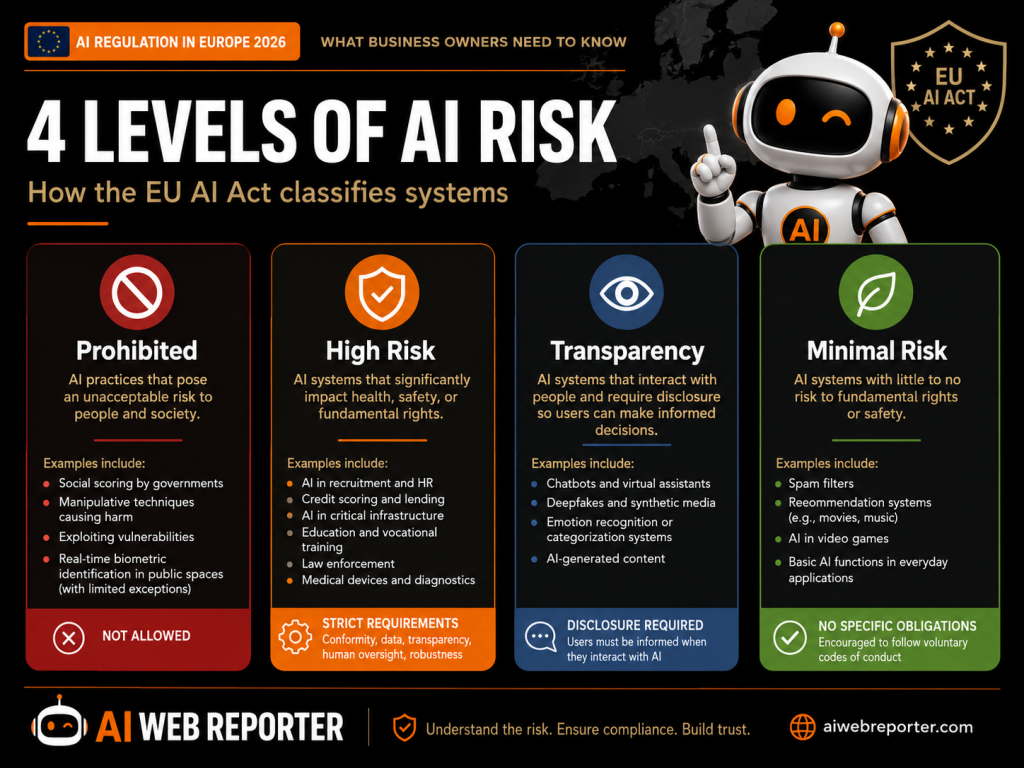
The AI Act uses a risk-based structure.
1. Prohibited AI practices
Some AI uses are considered unacceptable because of their potential impact on fundamental rights and human behaviour.
Examples include certain systems that use harmful manipulation, exploit vulnerabilities, create social scores, perform particular forms of individual criminal-risk prediction, scrape images indiscriminately to build facial-recognition databases, or infer emotions in workplaces and educational institutions, subject to limited exceptions.
These prohibitions have applied since February 2025.
Most ordinary business tools do not fall into this category. However, companies should still review employee monitoring, emotion analysis, biometric categorisation and highly manipulative customer-engagement systems carefully.
2. High-risk AI systems
High-risk AI systems are systems that may significantly affect health, safety or fundamental rights.
Examples include certain AI uses in:
- recruitment and employee management;
- access to education;
- creditworthiness assessments;
- life and health insurance;
- essential public or private services;
- medical devices;
- biometric identification;
- migration and border management;
- law enforcement;
- critical infrastructure.
The intended purpose of the system matters. A general writing assistant is not automatically high-risk. An AI system used to filter job applicants or influence a person’s access to credit may be.
Providers of high-risk systems may face requirements involving risk management, data quality, documentation, logging, transparency, human oversight, cybersecurity, accuracy, conformity assessments and ongoing monitoring.
Deployers may need to follow instructions, monitor the system, assign human oversight, use relevant input data, report incidents and inform affected people in certain circumstances.
3. AI systems with transparency obligations
Some AI systems may not be high-risk but must still be transparent.
From 2 August 2026, people in the EU generally need to be informed when they are interacting directly with an AI system where that fact is not already obvious.
Providers of generative AI systems will also need to support machine-readable detection of certain artificially generated or manipulated outputs. Deployers may need to disclose deepfakes, AI-generated public-interest publications and certain uses of emotion recognition or biometric categorisation.
This category may affect more everyday businesses than the high-risk category.
Examples include:
- website chatbots;
- automated customer-service agents;
- AI-generated promotional images;
- synthetic voices;
- AI-generated videos;
- deepfake-style content;
- AI-generated articles about matters of public interest.
Businesses should begin reviewing how AI interaction and generated content are labelled.
4. Minimal-risk AI systems
The majority of AI systems are considered minimal or limited risk and can continue to be used under existing laws without extensive new AI Act requirements.
Examples may include:
- spam filters;
- internal writing assistance;
- basic document summaries;
- product recommendation systems;
- AI-assisted scheduling;
- internal idea generation;
- low-impact workflow automation.
Minimal risk does not mean “no responsibility.”
Copyright, confidentiality, consumer law, employment law, contractual duties and data-protection rules may still apply.
AI literacy is already a business obligation.
AI literacy is one of the most relevant requirements for ordinary businesses because it already applies.
Providers and deployers of AI systems should take measures to ensure that employees and other relevant people have a sufficient level of AI literacy. The appropriate level depends on the organisation’s role, the risks of its AI systems, employee knowledge and the context in which AI is used.
The European Commission does not prescribe one fixed course or examination for every business.
A practical AI literacy programme may include:
- which AI systems the company uses;
- what each tool can and cannot do;
- what data employees may upload;
- how confidential information should be handled;
- how AI outputs should be checked;
- where human approval is required;
- how bias or unsafe results should be reported;
- how customers should be informed;
- when employees should stop using a tool.
Simply asking staff to read an AI tool’s instructions may not be sufficient in every context, especially where the system creates greater risks or requires human oversight.
For small businesses, a short written policy plus practical staff guidance is a reasonable starting point.
Read the official European Commission AI literacy guidance for more information about staff knowledge, training and organisational responsibilities.
What the transparency rules mean for marketing and customer service
Many businesses now use chatbots, synthetic voices, generated images and AI-assisted articles.
The 2026 transparency rules mean companies should review how clearly they communicate the use of AI.
A customer should not be misled into believing they are communicating with a person when they are interacting with an automated AI system.
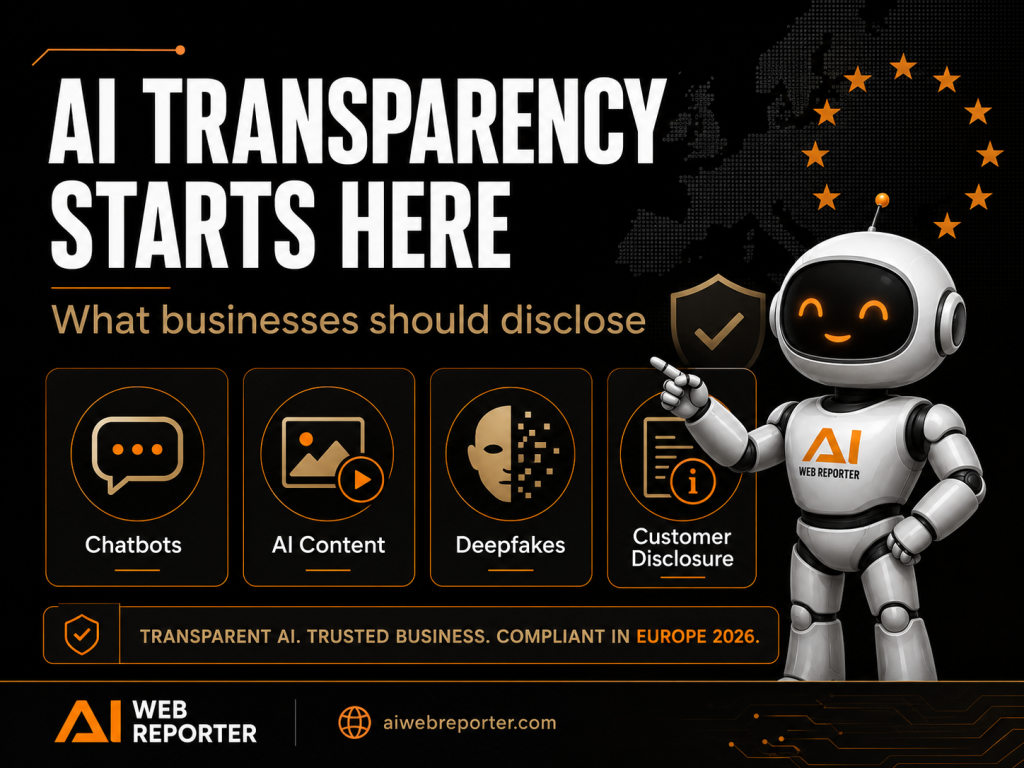
Businesses should also prepare for clearer labelling of certain AI-generated or manipulated content.
A practical transparency checklist may include:
- identify customer-facing AI systems;
- disclose when a chatbot is automated;
- avoid giving an AI agent a fake human identity;
- label synthetic or manipulated media when required;
- maintain records of AI-generated public-interest content;
- confirm whether vendors support machine-readable marking;
- create a process for correcting misleading outputs.
Transparency should not be treated as a small footer added at the last minute.
It should be part of the customer experience.
The European Commission has also published a Code of Practice on Transparency of AI-Generated Content to support the labelling and detection of AI-generated and manipulated material.
The EU AI Act does not replace GDPR.
The AI Act and GDPR address related but different risks.
The AI Act focuses on the safety, transparency and responsible use of AI systems.
The GDPR protects personal data regardless of which technology processes it. It applies to automated and manual processing when personal data falls within its scope.
A business may therefore need to comply with both.
For example, an AI recruitment tool may be relevant under the AI Act because it influences employment decisions. It may also be relevant under GDPR because it processes applicants’ personal information.
Businesses should ask:
- Is personal data being uploaded to an AI tool?
- Where is that data stored?
- Is the vendor using the data for model training?
- What is the legal basis for processing?
- Is data transferred outside the EU?
- How long is it retained?
- Can the organisation respond to data-subject requests?
- Does automated decision-making significantly affect individuals?
GDPR restrictions may apply to decisions based solely on automated processing that produce legal or similarly significant effects.
An AI Act review should therefore include the organisation’s data-protection officer, privacy adviser or responsible internal person where appropriate.
A 10-step AI compliance checklist for small businesses
Business owners do not need to begin with a complicated legal project.
The European Commission’s AI information platform includes resources designed to help businesses understand their possible AI Act responsibilities.
Explore the AI Act Service DeskStart with the following practical checklist.
1. Create an AI inventory
List every AI tool currently used by the business.
Include official tools, browser extensions, chatbots, automation platforms, and tools employees may have adopted without formal approval.
2. Record the purpose
Write down what each tool does.
Examples:
- generates marketing copy;
- answers customer questions;
- analyses job applicants;
- predicts sales;
- summarises contracts;
- produces images;
- recommends pricing;
- evaluates credit risk.
3. Identify affected people
Determine whether the tool affects:
- customers;
- employees;
- job applicants;
- students;
- patients;
- borrowers;
- members of the public.
4. Identify your role
Clarify whether your company is a provider, deployer, importer, distributor, or only an internal user.
5. Classify the risk
Check whether the use appears prohibited, high-risk, transparency-related, or minimal risk.
Do not classify the tool only by its brand name. Classification depends heavily on how and why it is used.

6. Review vendor documents
Ask vendors for:
- AI Act information;
- data-processing terms;
- security documentation;
- model limitations;
- logging options;
- human-oversight controls;
- AI-content marking support;
- incident-notification processes.
7. Create an employee AI policy
Define approved tools, prohibited data, review requirements, and escalation procedures.
8. Train relevant staff
Provide AI literacy guidance that matches each employee’s tasks and exposure to risk.
9. Add human review
High-impact outputs should not be accepted automatically.
Recruitment, financial, legal, health and employee-management decisions need stronger review than low-risk marketing drafts.
10. Keep evidence
Maintain records showing:
- which systems are used;
- what training was given;
- what risks were considered;
- which vendor checks were performed;
- how incidents and complaints are handled.
Documentation helps demonstrate that the business took AI governance seriously.
Common mistakes businesses should avoid
The first mistake is assuming that using a famous AI platform automatically makes the business compliant.
The vendor may manage the model, but the business remains responsible for how it uses the output.
The second mistake is allowing employees to use any AI tool without rules.
This creates risks involving confidential information, personal data, inaccurate output, and inconsistent customer communication.
The third mistake is treating AI-generated content as automatically accurate.
Human review remains necessary.
The fourth mistake is waiting until enforcement begins before documenting AI use.
Creating a basic inventory and policy now is easier than reconstructing the business’s AI usage later.
The fifth mistake is assuming that the AI Act is the only relevant law.
GDPR, consumer protection, copyright, employment law and sector-specific rules may also apply.
Related Reading
Explore how artificial intelligence is changing financial services, regulation and everyday money tools.
Read practical AI news, explainers and analysis without unnecessary hype.
Understand where AI-generated financial information may begin to look like regulated advice.
What happens next?
The next phase of European AI regulation will focus on implementation.
The Commission and national authorities are developing guidance, standards, enforcement structures and compliance tools. A May 2026 political agreement also introduced simplification measures and revised parts of the high-risk timeline.
Businesses should therefore avoid relying on a compliance checklist once and forgetting about it.
Review AI systems regularly.
Monitor new guidance.
Update employee training.
Recheck vendors.
Document significant changes in how AI is used.
The goal of AI governance should not be to stop innovation.
It should be to help the organisation use AI without creating risks it does not understand.
Frequently Asked Questions
Does the EU AI Act apply to small businesses?
Yes. The EU AI Act can apply to businesses of any size depending on their role and how they develop, sell or use an AI system. The exact obligations depend on the intended purpose and risk level of the system.
Is ChatGPT automatically considered a high-risk AI system?
No. A general-purpose AI tool is not automatically high-risk simply because a company uses it. The use case matters. Drafting an internal email is different from using AI to influence recruitment, lending or access to an essential service.
Do businesses need to tell customers when they are speaking to an AI chatbot?
Relevant transparency rules generally require people to be informed when they are directly interacting with an AI system where that fact is not already obvious. Businesses should review their customer-facing chatbots and automated agents.
Is AI training mandatory for employees?
Providers and deployers must take measures to ensure a sufficient level of AI literacy among relevant staff. The appropriate training depends on employee knowledge, the business context and the risks associated with the AI systems being used.
Does EU AI Act compliance also mean GDPR compliance?
No. The EU AI Act and GDPR have different requirements. When an AI system processes personal data, the organisation may need to comply with both laws as well as any relevant sector-specific rules.
Final takeaway
AI regulation in Europe in 2026 is becoming operational.
For most small businesses, the immediate priorities are clear:
- understand which AI systems are being used;
- train employees;
- protect confidential and personal data;
- disclose customer-facing AI where required;
- keep humans involved in important decisions;
- review vendors;
- document the company’s approach.
The businesses that prepare early will not only reduce regulatory risk.
They will also build greater trust with customers, employees and partners.