

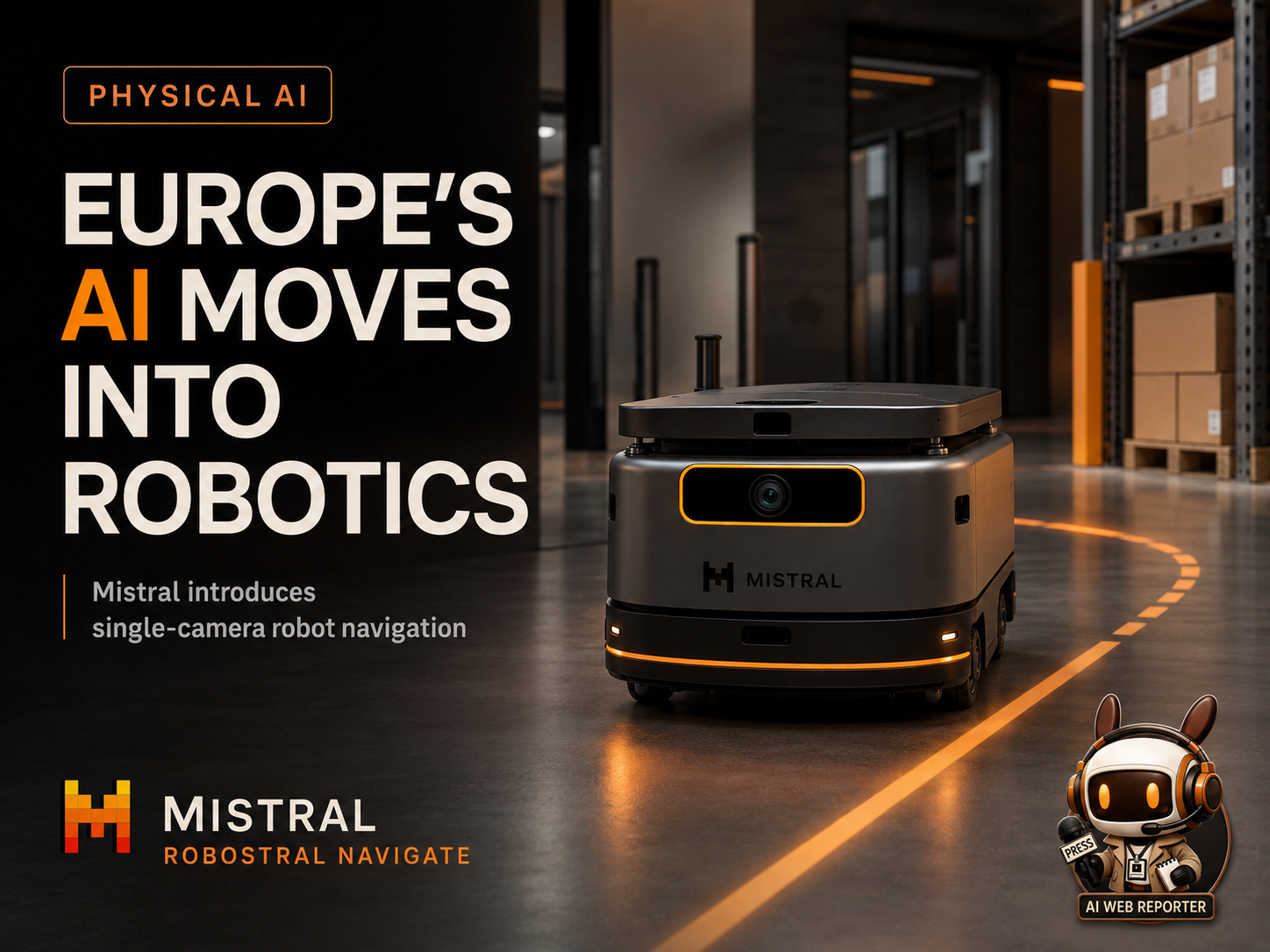
Europe’s AI competition is moving beyond chatbots and into machines that can understand and navigate the physical world.
AI Web Reporter · No hype. Just signal.For most people, the recent artificial intelligence boom has been defined by chatbots, image generators and coding assistants. Mistral AI is now extending that competition into machines that can move through the physical world.
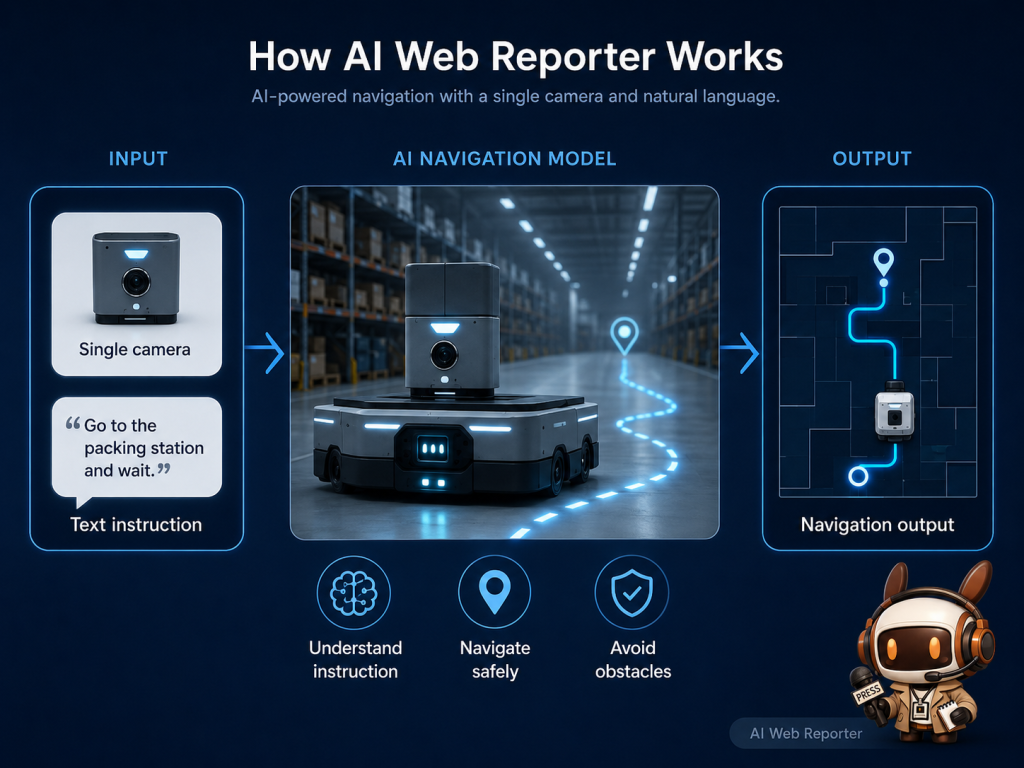
The Paris-based AI company has introduced Robostral Navigate, its first model designed specifically for robotic navigation. The model accepts visual information from a single standard camera, combines it with a plain language instruction, and determines how a robot should move through its environment.
The launch is significant because Robostral Navigate does not depend on LiDAR, depth sensors, or a collection of cameras. Mistral says an ordinary RGB camera is enough for the model to understand its surroundings and guide a robot towards its destination.
That does not mean general-purpose robots are ready for every workplace. The technology is focused on navigation, not the complete set of physical skills that a useful workplace robot may require. Still, it provides another sign that Europe’s AI ambitions are expanding beyond language models and software assistants.
What Is Robostral Navigate?

Robostral Navigate is an 8 billion parameter model created for embodied navigation.
In simple terms, embodied navigation means helping a machine understand its location, interpret instructions, and move through a real or simulated environment.
A user could give the robot an instruction such as leaving a lobby, passing through a corridor, entering a supply room, and stopping in front of a particular shelf. Robostral Navigate processes the instruction alongside images from the robot’s camera and predicts where the robot should move next.
Mistral says the model can operate across wheeled, legged, and flying robots. It is also designed to work with robots of different sizes and camera configurations. This could make the navigation system more flexible for companies that use hardware from different suppliers.
The model is not a robot by itself. It does not manufacture hardware, control every motor function, or automatically solve every safety problem. It provides the intelligence needed to interpret an environment and select a navigation direction.
How Does Robostral Navigate Work With One Camera?
Many robotic navigation systems use depth cameras, LiDAR, or several cameras to build a detailed understanding of the surrounding space.
Robostral Navigate takes a different approach.
Mistral AI official announcementThe model normally predicts a point within the current camera image and identifies the direction the robot should face when it arrives. Mistral describes this as navigation through pointing.
This method allows the model to focus on a visible destination instead of calculating every movement through fixed measurements. When the intended destination is outside the current camera view, the system can switch to instructions based on the robot’s local position, such as moving forward a certain distance and turning in a specified direction.
Using one camera could reduce the number of specialised sensors required for some robotic systems. However, fewer sensors do not automatically mean that a complete robotic deployment will be inexpensive or simple. Businesses would still need suitable hardware, computing resources, integration work, safety controls and ongoing maintenance.
What Do Mistral’s Benchmark Results Show?
Mistral reports that Robostral Navigate achieved a success rate of 79.4 percent on the seen validation section of the R2R CE benchmark. It achieved 76.6 percent on the unseen validation section.
The unseen section is especially important because it measures whether a model can follow instructions in environments that were not included in its training data.
According to Mistral’s official announcement, the unseen result exceeded the strongest previous single-camera approach by 9.7 percentage points.
The company also says it exceeded the best system using depth information or multiple cameras by 4.5 percentage points.
These figures should be interpreted carefully. They are company-reported benchmark results and should not be treated as independent proof that the system will achieve the same level of reliability inside every factory, warehouse, hotel or commercial building.
Real workplaces include changing lighting, reflective surfaces, moving equipment, blocked routes, crowds and unexpected human behaviour. Reliable performance in these conditions will require independent testing and careful deployment.
Independent reporting from Reuters also confirms that the model is focused on robotic navigation and industrial applications.
How Was Robostral Navigate Trained?
Mistral says Robostral Navigate was developed internally and does not depend on an existing open-source vision language model.
The company says its training data was generated through simulation. Around 400,000 navigation trajectories were created across 6,000 simulated scenes.
Simulation allows researchers to expose a model to many routes, obstacles and environments without physically operating thousands of robots.
Mistral also used a method called prefix caching to improve training efficiency. The company says this reduced the number of required training tokens by a factor of 22 compared with processing every moment of a navigation episode separately.
After supervised training, Mistral applied online reinforcement learning. This allows the system to improve through trial and error, recover from unsuccessful actions, and explore alternative routes.
Mistral reports that this stage improved the model’s success rate by 3.2 percentage points.
Why Does This Matter for European Technology?
Robostral Navigate shows that Mistral is building a broader industrial AI strategy.
The company is no longer focused only on models that generate text, analyse documents or assist with software development. It is also developing systems that can understand physical environments and potentially support machines operating inside them.
This matters for Europe because the region already has strong expertise in industrial manufacturing, automotive engineering, logistics, aerospace and robotics.
The opportunity is not simply to create a European version of an existing chatbot. It is to combine artificial intelligence with industries where European companies already have technical knowledge, infrastructure and customers.
Mistral’s move into robotics also fits with its wider industrial ambitions, including its agreement to acquire Austria-based Emmi AI, a company focused on physics-based artificial intelligence for engineering and industrial applications.
For European businesses, the most important question will be whether these systems can move from research benchmarks into safe, reliable and commercially useful deployments.

Possible Business Applications
Mistral identifies manufacturing, logistics, delivery and hospitality as possible application areas for Robostral Navigate.
Manufacturing
Navigation models could help mobile robots move materials between work areas, support routine transport tasks and adapt when routes change inside a facility.
Warehouses and Logistics
Robots could navigate storage areas, move between sections and respond to changing obstacles or updated instructions.
Commercial Buildings
Navigation systems could support delivery, inspection, facility checks and routine movement through offices, hospitals or public buildings.
Hospitality
Service robots could potentially move between reception areas, corridors and rooms while following location-based instructions.
These examples remain potential applications. The launch announcement does not prove that the model is already operating at scale across all of these industries.
What Robostral Navigate Cannot Yet Do
The most important limitation is the difference between navigation and manipulation.
Navigation allows a robot to move from one location to another. Manipulation allows it to pick up an object, open a door, use a tool, or interact physically with equipment.
A robot that can find a shelf but cannot safely collect an item from it still needs additional hardware, control systems, and intelligence.
Businesses should also consider several practical questions before evaluating this type of technology.
- How reliably does the system operate outside simulation?
- How does it respond to people, vehicles and unexpected obstacles?
- What happens when the camera becomes blocked or damaged?
- What computing hardware is required on the robot?
- Can the system be integrated with existing safety controls?
- How is visual information stored and processed?
- Who is responsible when the robot makes an incorrect decision?
Independent reporting from Reuters also notes that the model is focused on navigation rather than object handling.
What Happens Next?
Robostral Navigate should be viewed as an early foundation rather than a complete general-purpose robotics system.
Mistral says navigation is the first step towards a unified embodied agent. The company plans to continue expanding its robotics work through additional training, testing and experimentation.
The next stage will be judged through independent evaluations, commercial pilots and performance in uncontrolled environments.
It will also be important to see whether Mistral can combine navigation with perception, reasoning and physical manipulation.
Robostral Navigate does not prove that robots are ready to take over complex workplaces. It does show that the AI competition is moving beyond screens and into machines that must understand and operate within the physical world.
For Europe, that shift may create an opportunity to connect artificial intelligence research with the region’s strengths in manufacturing, engineering and industrial technology.
Frequently Asked Questions
Clear answers to the main questions about Mistral Robostral Navigate, its technology and its possible business impact.
What is Robostral Navigate?
Robostral Navigate is Mistral AI’s first model designed for embodied robot navigation. It combines images from one RGB camera with plain language instructions to guide a robot through an environment.
Does Robostral Navigate require LiDAR?
Mistral says the model operates without LiDAR, depth sensors or multiple cameras. It uses one standard RGB camera.
Can Robostral Navigate pick up objects?
The model is focused on navigation rather than object handling or manipulation. A complete robot would require additional systems to perform physical tasks.
Was the model trained on real robots?
Mistral says the training data was generated through simulation using about 400,000 trajectories across 6,000 scenes.
Why is Robostral Navigate important for Europe?
The model reflects Mistral’s growing focus on industrial AI and robotics. It may help connect European AI research with manufacturing, logistics, engineering and industrial automation.
Sources
- Mistral AI official Robostral Navigate announcement
- Reuters report on Mistral’s robotics model
- Mistral AI industrial strategy and Emmi AI announcement
Follow AI Web Reporter for clear and verified AI and technology analysis.