


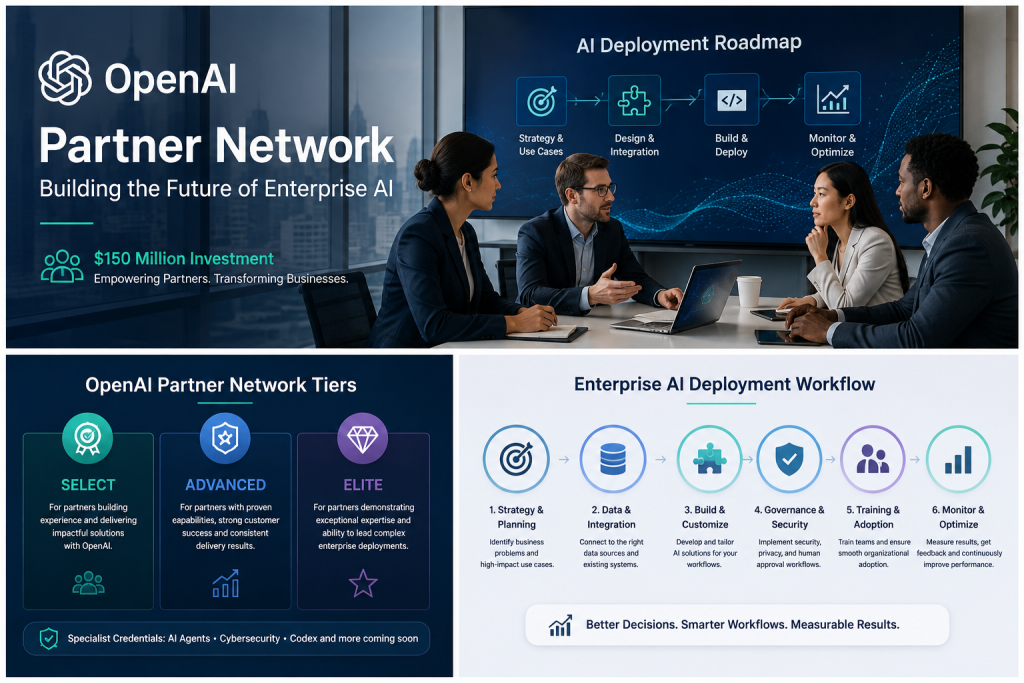
OpenAI has launched a global Partner Network designed to help organizations move from artificial intelligence experiments to practical business deployment.
The company is supporting the program with a 150 million dollar investment intended to strengthen the partner ecosystem and accelerate enterprise AI adoption.
The announcement is important because many companies already have access to powerful AI models, but still struggle to connect those models to real business processes, approved data, existing software, and employee workflows.
The OpenAI Partner Network aims to close that implementation gap.
What is the OpenAI Partner Network?
The OpenAI Partner Network brings together consulting firms, technology providers, software developers, and implementation specialists that help organizations adopt OpenAI technology.
These partners may support businesses with AI strategy, workflow redesign, system integration, employee training, change management, and governance.
Some partners may focus on technical development, while others may help companies identify high-value use cases or manage organizational adoption.
The network is designed to provide customers with a clearer way to identify partners that have experience building and deploying AI systems.
This is different from simply selling access to an AI model.
The partner is expected to help the customer turn AI capabilities into a complete operational system.
How the OpenAI Partner Network works
The program includes three partner levels:
Select
Select partners are organizations that have started building experience with OpenAI technology and customer deployments.
Advanced
Advanced partners are expected to demonstrate stronger technical capabilities, customer experience, and implementation performance.
Elite
Elite partners represent the highest level in the network and are expected to support more complex enterprise deployments.
OpenAI also plans to introduce specialist credentials in areas such as AI agents, cybersecurity, and Codex.
These specializations could help customers identify partners with deeper expertise in a particular area.
For consultants and development agencies, this means that verified skills and successful deployments may become increasingly important.

Why OpenAI is investing 150 million dollars
The investment signals that OpenAI sees implementation as a major part of the next stage of AI growth.
Businesses do not create value simply by purchasing access to an AI model.
They create value when the model is integrated into a process that improves speed, reduces cost, increases accuracy, or delivers a better customer experience.
This requires more than technical knowledge.
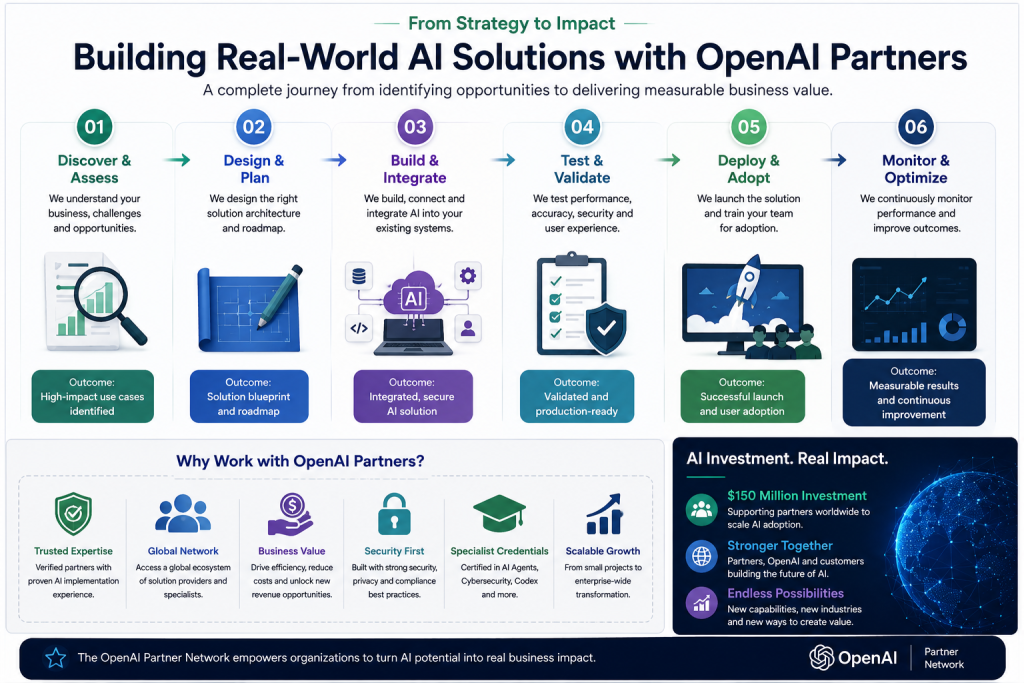
A successful AI deployment may involve business analysis, data preparation, software integration, privacy controls, employee training, security testing, and performance measurement.
OpenAI is investing in partners because these organizations can provide the practical support required to manage those tasks.
Why businesses need implementation partners
Many organizations begin their AI journey with a small demonstration.
They may build a chatbot, test an AI writing tool, or experiment with document summarization.
However, a demonstration is not the same as a reliable business system.
A production-ready AI solution may need to connect with customer relationship management software, email, internal documents, finance systems, or support platforms.
The company must also decide which tasks can be automated and which decisions require human approval.
For example, an AI customer-support system may be allowed to draft answers for common questions.
Refunds, complaints, legal issues, or sensitive customer cases may still require review by an employee.
An implementation partner can help design this complete workflow.
The partner can also define success metrics before the system is launched.
These metrics may include response time, cost per request, conversion rate, employee workload, or customer satisfaction.
What this means for AI consultants and developers
The Partner Network may create new opportunities for consultants, software developers, automation specialists, and technology agencies.
However, generic chatbot services may not be enough.
Businesses will increasingly look for partners that understand complete workflows, secure integrations, data governance, and measurable outcomes.
AI professionals may need to develop skills in the following areas:
- Business process mapping
- API and software integration
- Retrieval from approved data sources
- Human approval workflows
- Privacy and access controls
- Testing and monitoring
- Employee training
- Return on investment measurement
Industry knowledge will also become more valuable.
A consultant who understands healthcare, finance, retail, logistics, or manufacturing may be better positioned to design relevant AI systems for that sector.
What businesses should do before choosing a partner
Before selecting an AI implementation partner, a company should clearly define the problem it wants to solve.
The project should not begin with a tool.
It should begin with a business process that is slow, expensive, repetitive, or difficult to manage.
Businesses should ask the following questions:
- What specific problem are we solving?
- What data will the AI system use?
- Which software platforms must be connected?
- Where is human approval required?
- How will privacy and security be managed?
- Which performance metrics will be measured?
- Who will manage the system after deployment?
A strong partner should be able to answer these questions and provide a practical implementation plan.
What happens next?
The OpenAI Partner Network is likely to increase competition among consulting firms, automation agencies, software developers, and enterprise technology providers.
Recognized credentials and specialist certifications may become important signals for customers evaluating potential partners.
Large businesses may prefer partners that can demonstrate strong governance, secure architecture, industry expertise, and previous deployment results.
Smaller consultants may compete by specializing in a particular industry, workflow, or technical capability.
The wider message is that the AI market is moving from experimentation toward implementation.
The companies that gain the most value from AI may not be the ones that test the largest number of tools.
They may be the organizations that select one important process, build a reliable system, measure the outcome, and scale what works.
Do you think certified partner networks will improve the quality of enterprise AI deployment, or make it more difficult for smaller independent consultants to compete?