

NVIDIA and SK hynix have announced a multiyear technology partnership focused on developing next-generation memory for the global expansion of AI factories.
The collaboration is intended to support advanced AI infrastructure, accelerate semiconductor design and manufacturing, and expand the supply of memory technologies required for increasingly powerful artificial intelligence systems.
The announcement highlights an important reality about the AI industry: progress does not depend only on better models or faster processors. It also depends on the memory, networking, energy and data-centre systems that allow those models to operate at scale.

What NVIDIA and SK hynix announced
NVIDIA and SK hynix said they will work together over multiple years to advance next-generation memory for AI factories.
The companies plan to align memory development more closely with NVIDIA’s AI infrastructure roadmap.
The partnership also aims to expand supply for the growing global demand for AI systems and improve the way semiconductor technologies are designed and manufactured.
This type of cooperation is becoming increasingly important because modern AI systems rely on several components working together.
A powerful processor cannot perform efficiently if data cannot move quickly enough between storage, memory and computing resources.
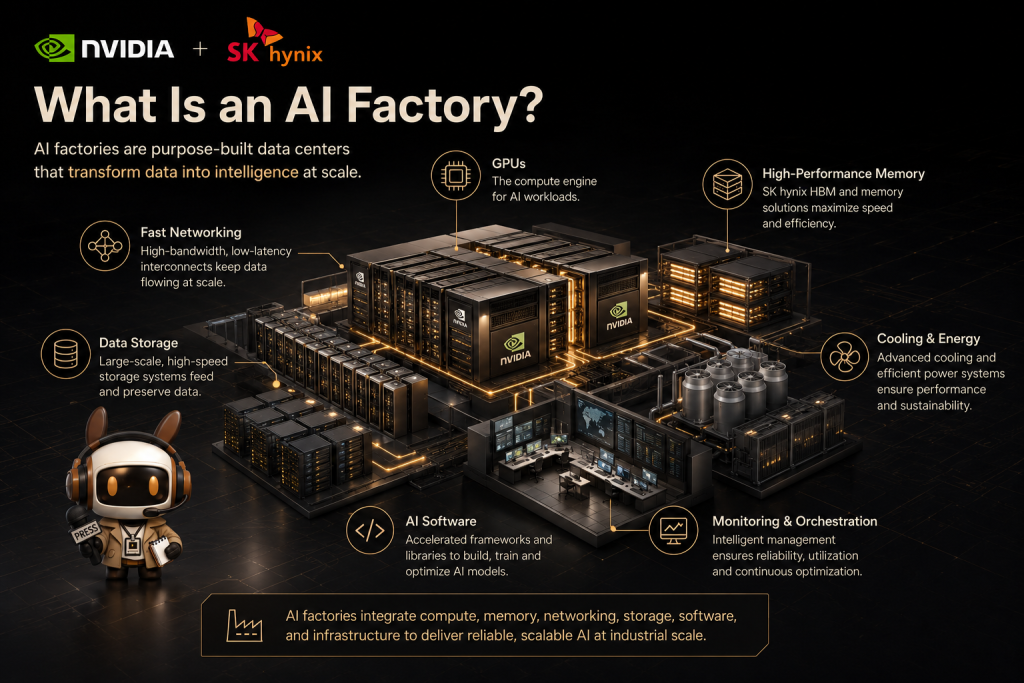
What is an AI factory?
An AI factory is a large-scale computing environment designed to train, run and improve artificial intelligence systems.
It typically combines:
- Graphics processing units
- High-performance memory
- Fast networking
- Data storage
- Cooling and energy systems
- AI software
- Monitoring and orchestration tools
The purpose of an AI factory is to transform data into useful AI outputs at scale.
These outputs may include language models, recommendation systems, digital twins, industrial automation, robotics, scientific simulations or AI agents.
NVIDIA has also described platforms such as NVIDIA DSX as a complete playbook for designing, deploying and operating AI factories.
Why memory matters for artificial intelligence
Artificial intelligence workloads process extremely large amounts of data.
During model training, information must move repeatedly between processors and memory.
If memory is too slow, the processor may spend time waiting instead of performing useful calculations.
This creates a bottleneck.
Advanced memory helps reduce that bottleneck by moving more data at a higher speed.
As AI models become larger and more complex, the demand for faster and more efficient memory increases.
This is why memory companies are becoming central to the AI infrastructure market.
What the partnership could improve
The NVIDIA and SK Hynix partnership could improve several parts of the AI infrastructure.
First, closer coordination may help memory technologies better match future NVIDIA computing platforms.
Second, the collaboration may accelerate the development of new memory designs for AI workloads.
Third, expanded supply could help address growing demand from cloud providers, enterprises and governments building AI infrastructure.
Fourth, the partnership may improve semiconductor research and manufacturing by combining AI computing with advanced memory engineering.
The result could be more efficient AI systems with better performance, higher capacity and improved scalability.
Why high-bandwidth memory is important
High-bandwidth memory, commonly known as HBM, is designed to move large amounts of data quickly.
It is especially useful for workloads where processors need constant access to large datasets.
AI model training and inference are strong examples.
HBM is placed close to the processor and uses a wide data interface to increase speed and efficiency.
This can help reduce delays between memory and computing resources.
For AI systems, faster memory can support:
- Larger models
- Higher training throughput
- Faster inference
- More complex simulations
- Better energy efficiency
- Larger AI agent workloads
The partnership between NVIDIA and SK hynix reflects the growing importance of HBM and other advanced memory technologies in the AI market.
How does this affect the global AI infrastructure race
Countries and companies are investing heavily in AI infrastructure.
Cloud providers are expanding data centres.
Governments are building sovereign AI platforms.
Technology companies are developing AI factories for research, manufacturing, public services and commercial applications.
NVIDIA is already involved in several large-scale AI factory projects, including collaborations focused on Korea’s AI infrastructure and advanced semiconductor development.
This competition is increasing demand for GPUs, memory, networking equipment, energy and specialized facilities.
The NVIDIA and SK Hynix partnership positions both companies to play a larger role in that expansion.
It also shows that the AI infrastructure race is becoming a full-stack competition.
Success will depend on the complete system, not only one component.
What businesses and developers should understand
Most businesses will not build their own AI factory.
However, the infrastructure behind AI services still affects them.
Better memory and computing systems may lead to:
- Faster AI applications
- More capable models
- Lower processing delays
- Improved cloud services
- Larger context windows
- More reliable enterprise deployments
Businesses should also understand that AI costs are influenced by infrastructure.
Training and running advanced models requires expensive hardware, energy and operational resources.
Improvements in memory efficiency may help providers offer better performance or reduce some operating costs over time.
Developers may also gain access to more powerful tools as infrastructure expands.

What happens next?
NVIDIA and SK hynix are expected to continue coordinating memory development with future AI infrastructure needs.
The partnership may lead to new memory technologies, expanded production capacity and closer integration between processors and memory systems.
Demand is likely to remain strong as AI factories grow in size and more organizations deploy AI at scale.
The long-term importance of the agreement will depend on how effectively the companies improve performance, efficiency and supply.
The wider message is clear.
Artificial intelligence progress is no longer only a software story.
It is also a hardware, memory, energy and infrastructure story.
Which part of the AI infrastructure race will matter most in the next five years: processors, memory, energy or data centres?
Official source
NVIDIA and SK hynix AI factory memory partnership announcement