
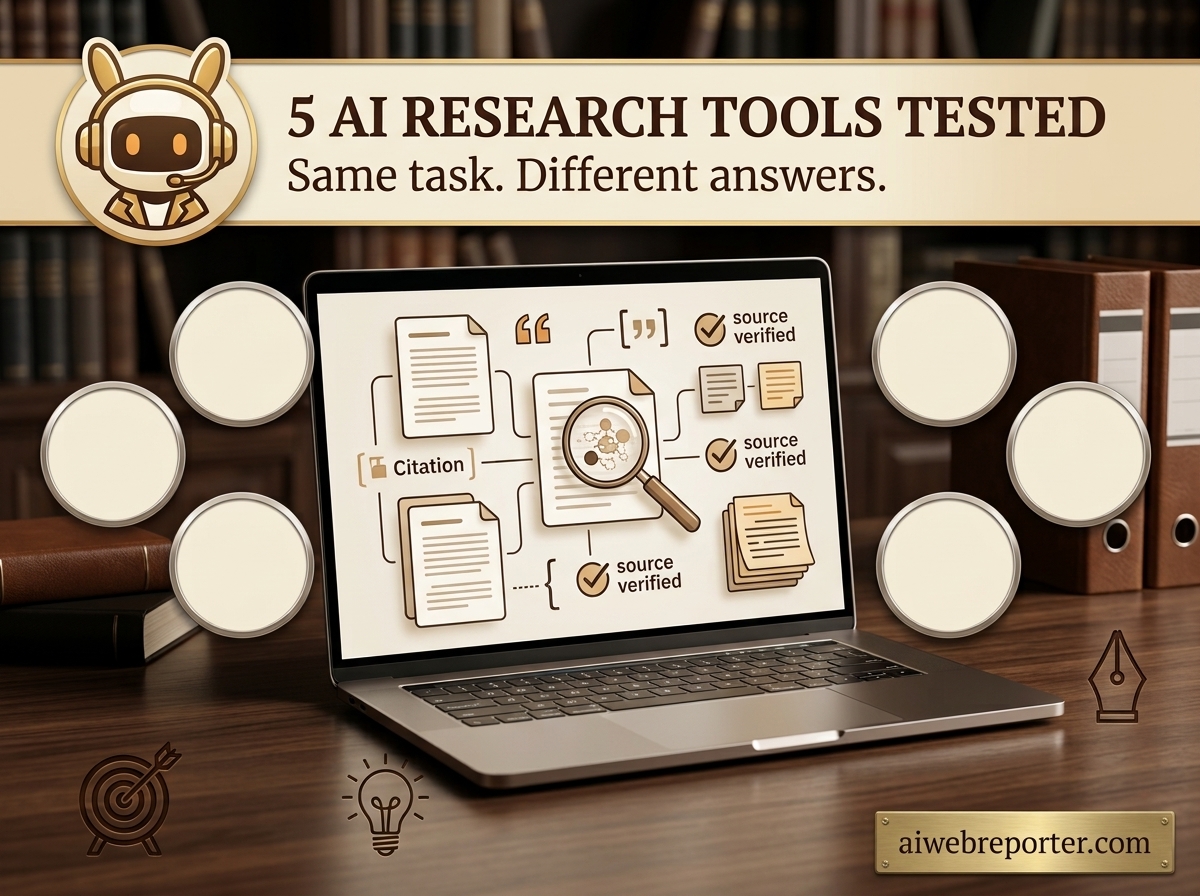
Small businesses do not need more AI subscriptions; they need reliable AI research tools that produce useful information without creating additional fact-checking, confusion, or risk.
An AI tool may generate a polished answer in seconds, but that does not automatically make the answer reliable. Weak citations, unsupported statistics, and confidently written assumptions can turn a time-saving tool into another source of work.
To examine this problem, AI Web Reporter gave five popular AI tools the same small-business research task:
- Claude
- ChatGPT
- Gemini
- Microsoft Copilot
- Perplexity
The goal was not to identify one universal winner. It was to see how differently these tools handled the same instructions, especially when asked to provide practical business advice supported by reliable primary sources. Small businesses exploring more practical options can also review our guide to the 7 best free AI tools for small business productivity.
Table of Contents
The Research Task
Every tool received the following prompt:
Research five practical ways a small business can use AI to reduce repetitive administrative work.
For each use case, include:
- A practical example
- The expected benefit
- The biggest risk or limitation
- Two reliable primary-source citations
Clearly identify anything that could not be verified.
Do not invent statistics, sources or case studies.
This prompt was deliberately strict.
We were not only asking for ideas. We wanted each tool to distinguish between verified evidence, general recommendations, and claims that could not be confirmed.
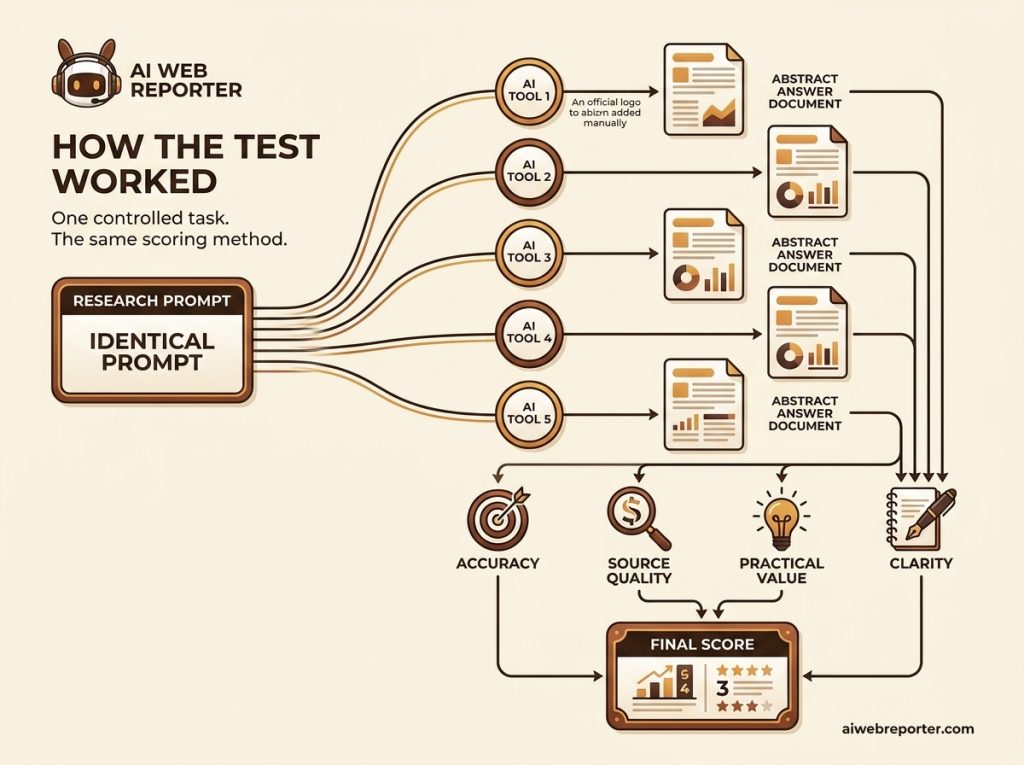
How the Tools Were Scored
Each response was evaluated across four categories:
| Criterion | What we evaluated |
|---|---|
| Accuracy | Whether the claims appeared reasonable, consistent, and appropriately qualified |
| Source quality | Whether the response used relevant and credible primary sources |
| Practical value | Whether a small business could act on the recommendations |
| Clarity | Whether the answer was structured, understandable and easy to review |
Each category was scored out of five, creating a maximum score of 20.
Speed was not scored because response times were not recorded consistently.
Final Results
| Rank | AI tool | Score | Main verdict |
|---|---|---|---|
| 1 | Claude | 18/20 | Best overall balance |
| 2 | ChatGPT | 17/20 | Strongest source discipline |
| 3 | Gemini | 15.5/20 | Most detailed response |
| 4 | Microsoft Copilot | 12.5/20 | Most claims requiring additional verification |
| 5 | Perplexity | 11.5/20 | Did not satisfy the citation requirement in this test |
These scores represent one controlled prompt test. They should not be treated as permanent rankings of the platforms, every model version, or every available research mode.
This was one controlled test using the same prompt. It is not a universal ranking, and performance may differ by model version, settings, prompt, and research task.
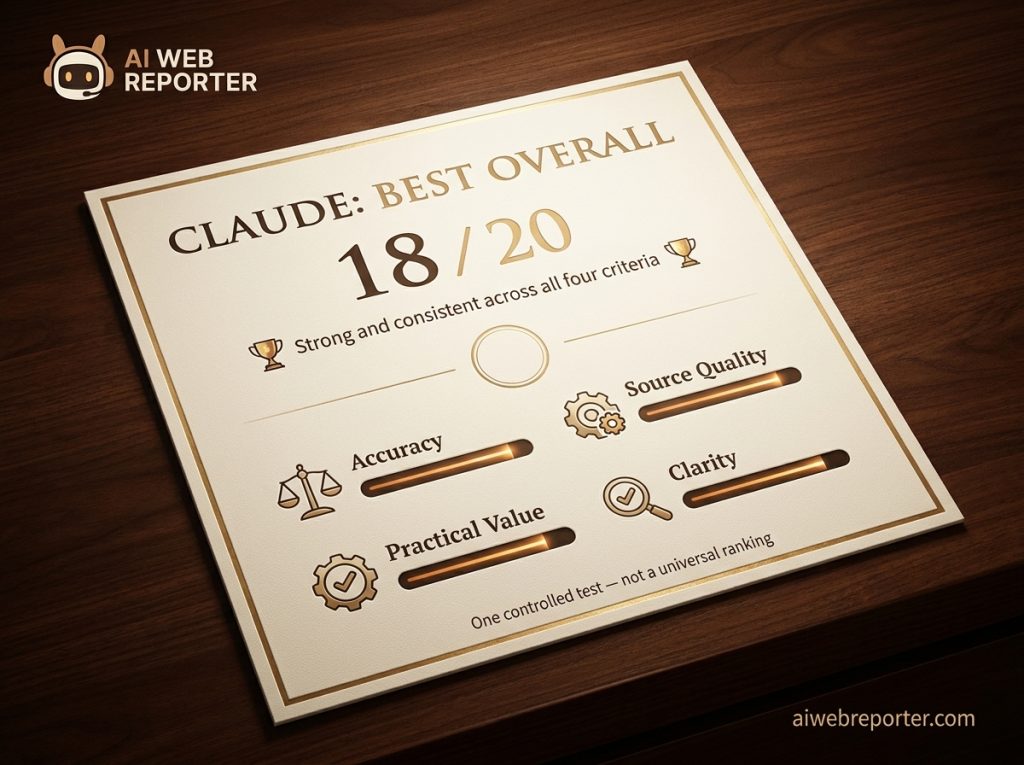
Claude: Best Overall Balance
Claude produced the strongest overall response in this test.
Its answer balanced practical recommendations, source coverage, readability, and appropriate caution. It provided broader evidence than the other tools while still identifying claims that were uncertain or required additional checking.
That balance matters for small businesses. A useful research assistant should not simply produce the greatest number of ideas. It should help the user understand which ideas are supported, which are reasonable but unverified, and where human judgement remains necessary.
Anthropic’s official Claude Research feature is designed to produce detailed answers with citations. Its Research feature can also work across connected Google Workspace information and the public web, depending on the user’s access and settings.
Best use case
Claude was the strongest option for creating a broad first research draft containing:
- practical business use cases
- balanced benefits and limitations
- multiple evidence types
- clear explanations
- visible uncertainty where appropriate
Main limitation
Even a well-structured Claude response still requires manual source review before it is used in a client report, financial decision, published article, or operational policy.
ChatGPT: Strongest Source Discipline
ChatGPT finished second overall but performed best in source discipline and caution.
Its response was narrower than Claude’s, but it avoided filling gaps with invented numbers or unsupported claims. The recommendations were closely tied to official Microsoft documentation, which made the answer safer but also limited the range of examples.
This created an important trade-off.
Claude offered broader research coverage, while ChatGPT produced a more conservative answer built around fewer, more controlled sources.
OpenAI states that ChatGPT Deep Research outputs include citations or source links, a sources-used section, and an activity history that allows users to review how the report was created. OpenAI also advises users to open and review linked sources before making important decisions.

Best use case
ChatGPT was particularly suitable for:
- source-controlled research
- compliance-sensitive drafts
- internal business documents
- research where unsupported statistics must be avoided
- users who prefer a cautious answer over a broader answer
Main limitation
The response relied heavily on one technology ecosystem. This improved consistency but reduced the diversity of evidence and examples. The wider shift towards longer, end-to-end professional AI work is also covered in our analysis of how newer AI models are changing everyday work.
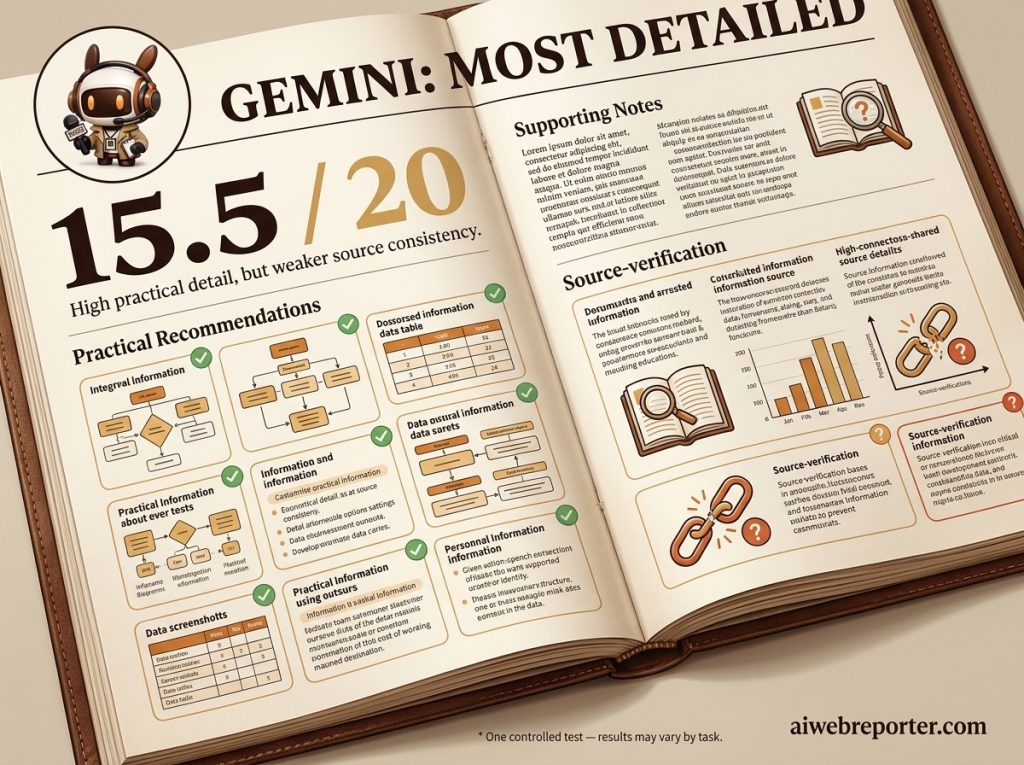
Gemini: Most Detailed, but Source Labels Needed More Care
Gemini generated one of the most detailed and practical responses.
Its answer contained strong examples, clear business benefits, and useful explanations. For a reader seeking ideas, it may initially have appeared more complete than the higher-ranked responses.
The main issue was source classification.
Some industry reports and secondary sources were presented as though they fully met the prompt’s requirement for primary evidence. Several precise figures also needed more independent verification before publication or business use.
Google provides source links and related-source features within Gemini, but its own documentation warns that a response may miss a source it used or cite information in a way that does not directly support a specific claim. Google therefore provides tools for reviewing related sources and double-checking responses.
Best use case
Gemini was useful for:
- generating a detailed idea bank
- exploring multiple administrative workflows
- creating an initial outline
- identifying areas for deeper research
- users already working inside Google’s ecosystem
Main limitation
The response needed stronger separation between primary sources, secondary research, and general industry commentary.
Microsoft Copilot: Practical Ideas, but the Highest Verification Burden
Copilot produced practical and clearly presented recommendations.
Its answer was easy to read and contained ideas a small business could understand quickly. However, it also included several precise claims supported by weaker blogs, vendor pages, or sources that did not provide enough confidence for a strict research brief.

That does not mean the ideas were necessarily wrong. It means the user would need to spend more time checking the claims before relying on them.
Microsoft explains that Copilot uses grounding to connect responses to work data or the web and can provide citations that users can inspect. Microsoft also recommends reviewing citations when checking accuracy.
Best use case
Copilot may be useful for:
- brainstorming workflows
- working with Microsoft 365 files
- creating a starting draft
- turning existing workplace information into structured notes
Main limitation
In this specific test, it created the largest additional fact-checking workload because several claims needed stronger supporting evidence.
Perplexity: The Citation Requirement Was Not Met in This Test
Perplexity finished last because the captured response did not provide the two primary-source citations requested for every use case.
That was a major failure under this test’s scoring system because source quality was a central part of the prompt.
However, this result requires context.
Perplexity officially describes itself as an answer engine that searches the web and provides citations linking to sources. Its documentation states that its standard and advanced search features are designed to support answers with citations.
The gap between the official capability and our received response may have resulted from the mode used, unavailable live access, account settings, or the specific way the answer was generated. Therefore, the result should be stated precisely:
Perplexity failed the citation requirement in this particular test. This does not mean Perplexity never provides citations.
Best use case
When citation-enabled search is working correctly, Perplexity may be useful for:
- quick web discovery
- finding potential sources
- identifying articles for further review
- beginning a broader research process
Main limitation
The output received in this test could not be treated as a publishable research brief because the requested evidence was missing.
The Most Important Result Was Not the Winner
The biggest lesson was not that Claude scored one point higher than ChatGPT.
The more important finding was that the same prompt produced five very different levels of confidence, evidence, and verification work.
A polished answer can still contain weak evidence. A shorter answer can be more useful when it makes fewer unsupported claims. A detailed answer can save brainstorming time but create more fact-checking work later.
For a small business, the best AI tool is not always the tool that writes the longest response. It is the tool that reduces total work after research, review, and correction are included.
A Safer AI Research Workflow for Small Businesses
European organisations using AI for customers, employees, or important decisions should also understand the growing AI compliance requirements for businesses. Based on this test, the strongest approach is not to depend on one tool from beginning to end.
1. Use Claude for the broad first pass
Start with Claude when the task requires multiple use cases, balanced explanations, and broad evidence coverage.
The goal at this stage is to understand the topic and identify the most useful directions.
2. Use ChatGPT for source discipline
Take the strongest claims from the first draft and ask ChatGPT to:
- locate primary sources
- reject unsupported statistics
- separate evidence from assumptions
- identify claims that cannot be verified
This creates a second layer of quality control.
3. Open every important source manually
A citation is not proof by itself.
Check whether the source:
- exists
- supports the exact claim
- is current enough for the decision
- comes from the organisation or dataset being discussed
- has been represented accurately
4. Remove unsupported precision
Specific percentages, savings estimates and performance claims should be removed unless the underlying evidence clearly supports them.
Replacing an unsupported number with a transparent limitation is better than publishing false precision.
5. Separate evidence from recommendations
The final document should distinguish between:
- verified facts
- practical recommendations
- assumptions
- estimated benefits
- unverified claims
This makes the research easier to trust and easier to update.
How This Workflow Can Save Time and Money
The business value of AI research does not come from removing humans from the process.
It comes from reducing repetitive work such as:
- creating the initial research structure
- summarising long documents
- identifying possible use cases
- organising benefits and risks
- drafting comparison tables
- locating potential sources
- converting research into a briefing
The human reviewer can then spend more time checking high-impact claims and making decisions. Businesses should also measure whether the workflow is producing usable outcomes by tracking the real return on AI investment.
This approach can also reduce the need to pay for several overlapping AI subscriptions. A business may discover that it needs one primary research tool and one verification process rather than five tools performing similar tasks.
The correct choice depends on the work being completed, the evidence required and the consequences of an inaccurate answer.
Final Verdict
Claude was the strongest overall performer in this controlled test because it combined broad research, practical value, clarity and appropriate caution.
ChatGPT was the safest option for source discipline and avoiding unsupported claims.
Gemini delivered the most detailed response but required more careful source classification.
Copilot provided useful ideas but created the greatest verification burden.
Perplexity did not meet the citation requirement in the response we received, although citation-supported research remains an official part of the platform’s intended functionality.
The final recommendation is therefore not to trust any AI research output automatically.
Use AI to accelerate discovery, structure information, and prepare a first draft. Then verify the sources, remove unsupported claims, and apply human judgement before the work affects customers, money, policy, or reputation.
Final Verdict
This comparison reflects one prompt-based test conducted in July 2026 using the outputs available during that session. Tool features, models, access levels, and research modes may change. The scores represent the quality of the responses received in this experiment and are not permanent rankings of the companies or platforms.
Explore the Test Behind the Ranking
See the research question, scoring method and final results used to compare Claude, ChatGPT, Gemini, Copilot and Perplexity.
The Research Question
Which AI research tool gives the most trustworthy and practically useful answer for small-business research?
Replace the sentence above with the exact original prompt if your tested prompt used different wording.
How the Tools Were Evaluated
Each tool received the same research task and was scored out of five for every criterion, producing a maximum total score of 20.
Final Scoreboard
| Rank | AI Tool | Score | Test Result |
|---|---|---|---|
| 1 | Claude | 18/20 | Best overall |
| 2 | ChatGPT | 17/20 | Most balanced |
| 3 | Gemini | 15.5/20 | Most detailed |
| 4 | Copilot | 12.5/20 | Required more verification |
| 5 | Perplexity | 11.5/20 | Missed the citation requirement |
This was one controlled test. It is not a universal product ranking. Results may differ by model version, settings, prompt and research task.