Factory AI Applications in Manufacturing: Guide
Drafted with AI and published under the AI Web Reporter byline. How we write
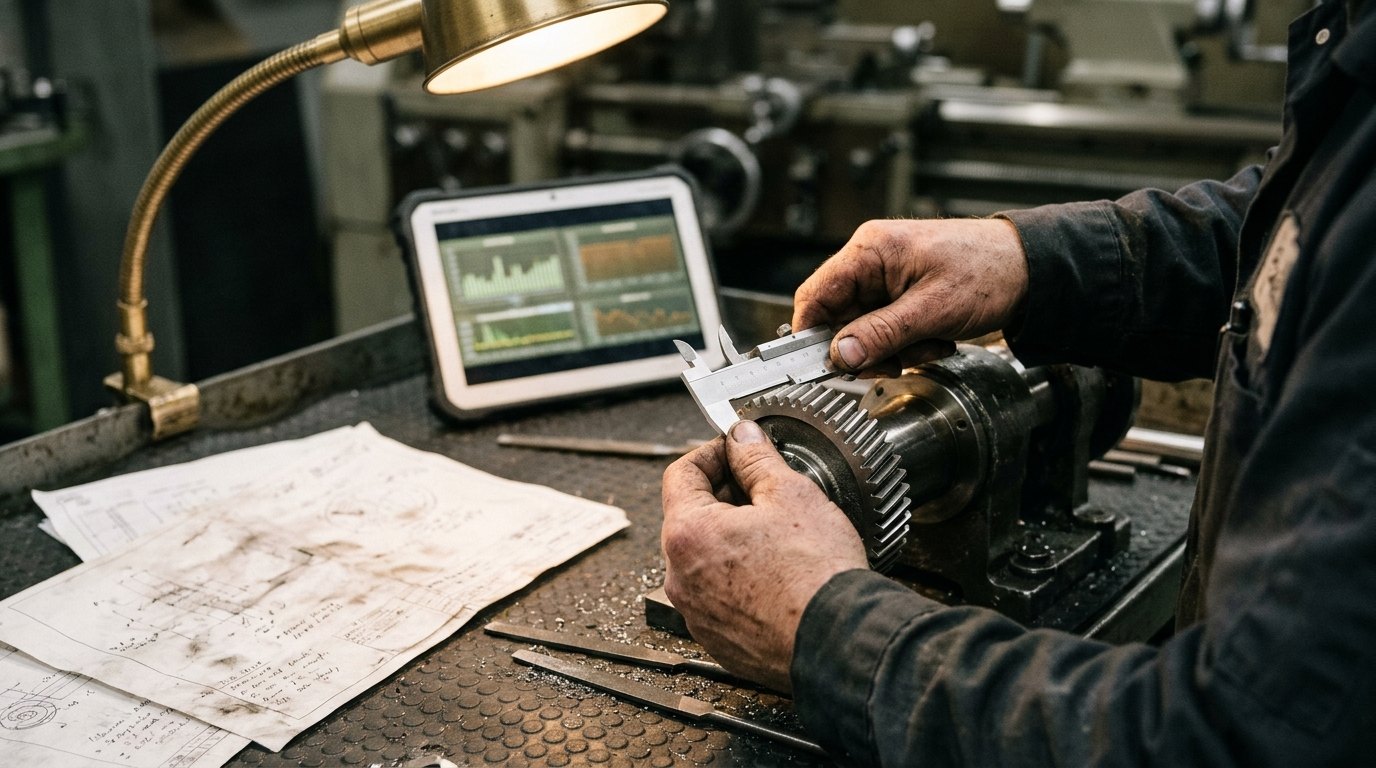
Modern factory ai applications in manufacturing 2025 center on four main areas: predictive asset maintenance, automated visual quality inspection, adaptive production scheduling, and AI-assisted maintenance logging. Rather than replacing physical machinery, these software systems consume sensor telemetry, camera streams, and enterprise data to catch equipment defects early, reduce unplanned downtime, and balance line throughput across industrial operations.
Key Takeaways
- Predictive maintenance shifts plant operations from fixed schedule servicing to condition-based interventions using vibration, thermal, and acoustic signals.
- Computer vision systems deployed at the network edge inspect components at line speed, flagging structural and visual flaws that manual sampling misses.
- Dynamic line scheduling algorithms continuously adjust work order sequences in response to machine outages, material delays, and emergency orders.
- Successful implementations focus first on high-cost bottlenecks with existing sensor data rather than facility-wide multi-year overhauls.
Modern Factory AI Applications in Manufacturing: What and Why
Industrial artificial intelligence in plant environments represents a shift from static, rule-based automation to adaptive systems. Traditional industrial automation relies on Programmable Logic Controllers (PLCs) and Supervisory Control and Data Acquisition (SCADA) networks. These systems operate on strict deterministic logic: if a sensor reading exceeds a predefined limit, the system triggers an alarm or stops a conveyor. While reliable for basic control loops, deterministic programming struggles to account for complex multi-variable interactions or gradual mechanical degradation.
Artificial intelligence applications complement existing SCADA infrastructure by analyzing multi-dimensional data streams over time. By processing high-frequency time-series data from vibration monitors, electrical current sensors, thermal imaging, and optical devices, machine learning models detect micro-patterns that precede component failures or quality drifts. This capability moves manufacturing analytics from reactive error logging to proactive intervention.
The operational logic behind deploying factory AI centers on asset utilization and material efficiency. Industrial plants carry heavy fixed capital costs. Unplanned downtime on a primary stamping press or assembly line halts downstream work blocks, creating idle labor and missed delivery windows. By identifying micro-cracks, thermal spikes, or lubrication breakdowns before a catastrophe occurs, teams shift repairs into scheduled maintenance windows.
Architecturally, modern manufacturing deployments balance edge computing with localized cloud or on-premise servers. Heavy computation—such as training deep neural networks—occurs on centralized servers. Model inference—the real-time evaluation of sensor inputs or video frames—takes place on edge acceleration hardware installed directly adjacent to the machinery. This hybrid setup keeps network latency low enough to match line speeds while maintaining operational continuity if an external internet connection drops.
Core Implementation Areas Across Production Lines
Industrial operations deploy software models across several distinct physical zones within a plant. Understanding where specific AI architectures fit prevents mismatched expectations and integration delays.
Predictive Maintenance and Asset Health
Mechanical components fail along predictable physics-based degradation curves, but the early stages of wear are rarely visible to human inspectors or simple threshold monitors. Predictive maintenance models ingest continuous streams of machine telemetry—primarily high-frequency vibration spectrums, motor current signature analysis (MCSA), and bearing temperatures. Anomaly detection models establish a baseline profile of a machine operating under normal loads and ambient conditions. When internal friction or shaft misalignment causes subtle harmonic variations, the model alerts maintenance engineering staff weeks before mechanical binding occurs.
Automated Visual Quality Inspection
Manual quality control relies on spot-checking a fraction of output, leaving batches vulnerable to undetected tool wear or surface defects. Computer vision systems mounted directly over conveyor lines capture high-frame-rate images under controlled LED lighting. Convolutional neural networks evaluate each item for surface porosity, dimension variances, missing fasteners, or weld anomalies. Edge inference hardware processes these images in milliseconds, triggering pneumatically driven rejection arms to eject non-conforming parts without slowing production speeds.
Dynamic Production Scheduling and Line Optimization
Plant scheduling historically relied on static daily or weekly production plans generated by Enterprise Resource Planning (ERP) systems. When a machine breaks down, a material delivery arrives late, or an urgent order takes priority, floor managers manually adjust schedules using spreadsheets. Reinforcement learning models and constraint solvers continuously analyze line status, tool availability, job setup times, and operator shift schedules. When disruptions occur, the scheduling system calculates alternative work order routings that minimize tool changeovers and preserve delivery deadlines. To scale these operational workflows efficiently, teams often deploy structured AI agents for business automation across order intake and scheduling systems.
Generative AI for Operator Support and Maintenance Logs
Unstructured data—such as shift handoff notes, PDF equipment manuals, and historic work orders—frequently remains trapped in siloed databases. Large language models (LLMs) tuned on industrial documentation allow technicians to query technical manuals and error histories using conversational text. A technician facing an unfamiliar error code on a CNC lathe can input the symptom and receive step-by-step diagnostic procedures along with references to historical fixes applied by other technicians across previous shifts.
A Worked Scenario: Visual Quality Control on a Machining Line
To evaluate how these systems function in a real production setting, consider a mid-sized automotive supplier manufacturing cast aluminum engine housings. The facility operates two shift lines producing finished castings that require strict dimensional accuracy and zero surface porosity.
Under the plant's legacy quality workflow, operators manually spot-checked five housings out of every batch of one hundred using manual calipers and visual inspections. When a cutting tool on a multi-axis CNC machine began to wear down, defect patterns often went unnoticed until thirty or forty defective housings had passed through the cell, resulting in high scrap volume and wasted energy.
The facility integrated an automated visual inspection unit onto the CNC cell's exit conveyor. The setup included two industrial optical cameras, a localized enclosure with high-CRI panel lighting, an edge processing node equipped with a hardware acceleration unit, and an integration module connected via Industrial Ethernet to the cell PLC.
The model was trained using thousands of historical images categorized into clean parts and six common defect classes (e.g., micro-porosity, deep tool scoring, edge burrs, missing tapped holes). During production, as each housing exits the wash station, optical sensors trigger the cameras. The edge node runs inference in 120 milliseconds, assigning a confidence score to the casting across each defect class.
| Operational Metric | Legacy Process (Manual Sampling) | Factory AI Deployment (100% Automated Vision) |
|---|---|---|
| Inspection Coverage | 5% of produced units (sample-based) | 100% of produced units (line speed) |
| Defect Catch Time | 30 to 60 minutes after occurrence | Immediate (under 1 second per part) |
| CNC Tool Wear Feedback Loop | Manual logging at end of shift | Automated alert when defect rate trends upward |
| Inspection Latency per Part | 2 to 3 minutes per sampled item | 120 milliseconds continuous edge evaluation |
| Root-Cause Data Capture | Paper logs and manual spreadsheet entries | Digital image archive indexed by serial and batch ID |
Example (illustrative numbers)
If the model flags three consecutive housings with burr defects in the same geometric location, the vision system communicates directly with the cell PLC to pause machine loading and issue an automated alert to the tooling technician. This closed feedback loop prevents the tool from damaging additional workpieces, containing scrap before whole batches are ruined.
Decision Framework: Choosing Your First Factory AI Project
Selecting the right initial application determines whether an industrial AI project establishes operational value or gets stalled in permanent pilot status. Facility managers must evaluate potential projects against technical feasibility, existing data infrastructure, and direct cost recovery mechanisms.
Before buying hardware or software licenses, organizations should establish explicit visibility into their operational bottlenecks using structured what is process discovery methodology. This mapping isolates where physical delays, high scrap costs, or labor bottlenecks actually occur, ensuring team resources target high-yield areas.
| Project Type | Data Requirements | Hardware Infrastructure Needed | Deployment Complexity | Primary Operational Risk |
|---|---|---|---|---|
| Predictive Maintenance | High-frequency sensor streams (vibration, current, temperature) | External IoT sensors, gateway modules, time-series storage | Medium | False positives leading to unnecessary maintenance overhauls |
| Automated Quality Vision | Annotated defect image libraries (labeled pass/fail instances) | High-resolution cameras, controlled LED lighting, edge acceleration nodes | Medium to High | Lighting shifts causing false rejections; unclassified defect types |
| Dynamic Production Scheduling | Real-time inventory levels, machine status feeds, ERP order backlog | Integration server software, API connectors to ERP and MES | High | Operator resistance; inaccurate master data leading to invalid schedules |
| LLM Assistant for Maintenance | Digitized equipment manuals, historical work orders, SOP PDFs | Localized cloud or enterprise server with secure data retrieval | Low to Medium | Model hallucinations delivering incorrect torque specs or diagnostic steps |
When choosing an initial pilot, apply a strict prioritization framework:
- Target high-cost downtime assets first: Focus predictive maintenance on single-point-of-failure machinery where an outage halts the entire production line.
- Verify existing telemetry quality: Confirm that target machines already log structured telemetry or that retrofitting low-cost vibration and thermal sensors is physically straightforward.
- Isolate inspection boundaries: For computer vision projects, select part families with defined geometry and consistent lighting conditions before attempting to inspect variable or reflective materials.
- Require clear human-in-the-loop fallback: Ensure operators can easily override automated recommendations without taking down the core SCADA control loops.
Technical and Operational Risks to Manage
While industrial AI software offers clear operational benefits, successful deployments require mitigating several real-world technical and organizational hazards.
Data Silos and Legacy Network Protocols
Older manufacturing facilities often operate machinery spanning multiple decades. Legacy PLCs may communicate via proprietary protocols or unshielded serial connections that lack native Ethernet connectivity. Extracting clean, synchronized telemetry requires installing secondary sensor arrays or utilizing protocol converters to translate Modbus, PROFIBUS, or legacy serial streams into modern OPC UA or MQTT data structures. Incomplete or noisy sensor signals degrade model accuracy, causing false alarms that erode operator confidence.
Model Drift and Operational Changes
Industrial machine learning models trained in controlled conditions degrade over time if the physical operating environment changes. Fluctuations in ambient shop floor temperature, humidity variations across seasons, altered raw material grades, or mechanical wear on conveyor belts alter sensor baselines. Without continuous model monitoring and periodic retraining, a visual inspection system calibrated in winter may start flagging false defects during summer months due to ambient daylight shifts through skylights.
Workflow Integration and Alarm Fatigue
An algorithm that identifies potential issues adds no value if its outputs do not connect directly into actionable daily maintenance routines. Generating hundreds of automated alerts every shift leads to alarm fatigue, causing technicians to ignore system recommendations altogether. Machine alerts must pass through contextual filtering logic before creating automated work orders in the plant's Computerized Maintenance Management System (CMMS). To streamline how machine data moves into daily tasks, teams should systematically automate business process with workflows so that maintenance tasks trigger with correct priorities, assigned parts lists, and technician schedules.
An algorithm that flags anomalies is useless if its outputs trigger alarm fatigue. AI systems must translate raw model alerts into context-aware, prioritized maintenance work orders that technicians trust.
Cybersecurity and Edge Isolation
Connecting operational technology (OT) systems to IT infrastructure expands the cyber-attack surface of a manufacturing facility. Direct cloud connections from PLCs or control networks risk exposing critical machinery to remote exploitation. Plant network architects must enforce strict network segmentation using industrial firewalls, unidirectional data diodes, and air-gapped local edge processing where strictly necessary, ensuring OT networks remain isolated from general enterprise traffic.
Frequently Asked Questions
How does factory AI differ from traditional automated manufacturing systems?
Traditional manufacturing automation operates on deterministic, rule-based logic programmed into PLCs (e.g., stopping a line when a limit switch opens). Factory AI applications analyze complex, high-dimensional data streams—such as vibration patterns or camera feeds—to detect subtle anomalies and adjust decisions dynamically without explicit step-by-step programming.
Do industrial AI deployments require continuous connections to the cloud?
No. Most plant deployments use cloud or local servers for initial model training, then deploy lightened inference models to localized edge hardware directly on the shop floor. This edge deployment ensures microsecond response times and allows production lines to run continuously even during internet outages.
What sensor infrastructure is required before deploying predictive maintenance?
Predictive maintenance requires consistent physical data streams from critical assets. Depending on the machine type, this involves retrofitting tri-axial vibration sensors, surface temperature thermistors, motor current transformers, or ultrasonic acoustic sensors, all connected to an industrial gateway running standard protocols like OPC UA or MQTT.
How do engineering teams handle training data requirements for visual defect inspection?
Teams collect high-resolution images of normal parts along with historical examples of defect types under controlled lighting. synthetic image generation, domain adaptation, and transfer learning techniques are often used to train accurate computer vision models even when real-world examples of rare structural flaws are limited.
Next Steps
- Audit your plant floor to identify single-point-of-failure machines where unplanned downtime creates immediate upstream or downstream bottlenecks.
- Evaluate the data readiness of those target assets by verifying existing sensor logs, network protocol access, and physical accessibility for retrofitting IoT gateways.
- Run a bounded, single-cell pilot project focusing on a single high-impact problem—such as visual defect screening or bearing health monitoring—before expanding AI models across broader facility operations.
Getting This Set Up For Your Business
Implementing industrial artificial intelligence on active production lines requires practical integration across specialized sensor hardware, edge compute nodes, and operational workflows. AI Web Reporter is connected to BMaiKR, an AI automation company that works directly with business owners and operations teams to design, build, and deploy custom automation and AI implementations tailored to specific industry requirements. Their engineering staff helps manufacturing operators move from initial process mapping to stable, production-grade automated systems.
Follow AI Web Reporter: Instagram



Comments
No comments yet. Be the first to share your thoughts!