



Claude Fermat Theorem headlines this week claimed a breakthrough. That’s not quite right, and the real story is more interesting than the hype.
Anthropic announced that Claude spent 11 days largely autonomously producing the first complete, computer-checked formalization of Fermat’s Last Theorem in the Lean programming language. The result: 13 million lines of code, 30,300 theorems proved, and roughly six billion output tokens consumed. It is now the largest formal Lean proof ever built.
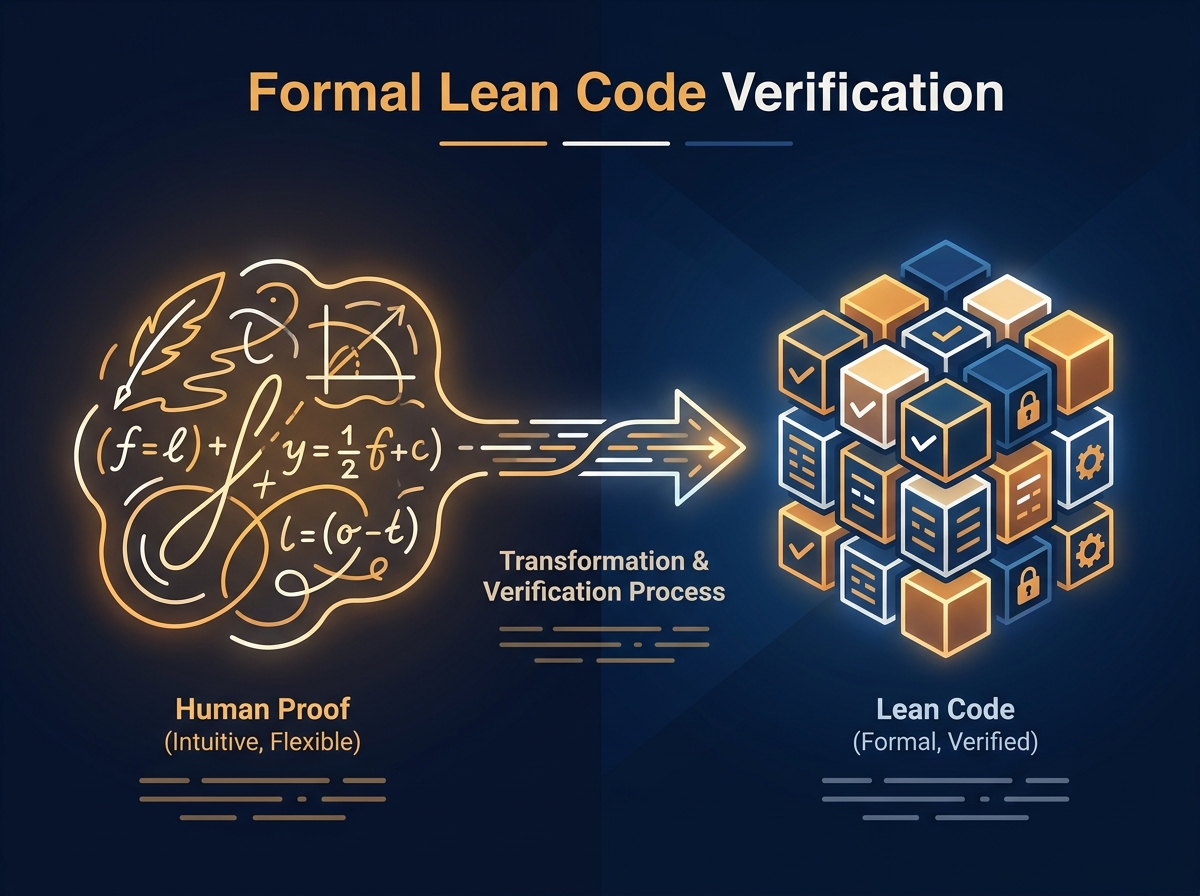
But Claude did not discover a new proof. Andrew Wiles already proved Fermat’s Last Theorem back in 1995, a result that took human mathematicians months to verify by hand. What Claude did was translate an established version of that proof into a format a computer can check line by line, with zero human-style ambiguity.
The Claude Fermat Theorem Proof: Why Formalization Is Hard
Mathematical proofs written by humans rely on shared intuition. A step that says “clearly this follows” makes sense to another mathematician, but a computer needs every single logical step spelled out with nothing left implicit. Converting an accepted proof into that fully explicit form is called formalization, and it is notoriously slow, tedious work.
Fermat’s Last Theorem was widely considered one of the hardest remaining formalization targets precisely because Wiles’s proof spans multiple advanced areas of mathematics. Kevin Buzzard, the Imperial College London mathematician who has led a separate community effort to formalize the theorem, reviewed Claude’s result and called it an extraordinary achievement, adding that it suggests full formalization of modern mathematical literature may be closer than expected.
How the Run Actually Worked
Claude did not work alone in a vacuum. The project ran on Prove2Me, an open collaborative platform built by Anthropic researcher Tianyi Peng’s group at Columbia University specifically for coordinating AI-driven formalization. Prove2Me maintains a dependency graph of every theorem needed for the final proof, letting multiple Claude agents work on different branches in parallel without stepping on each other’s work.


Dozens of Claude agents ran simultaneously across this graph, proving intermediate theorems and feeding them back into the shared structure. Humans stayed in the loop only for occasional high-level nudges, things like flagging which theorem to prioritize next, not for solving the mathematics itself.
The final proof relies on nothing but Lean’s three standard axioms. No shortcuts, no placeholder gaps. It was checked by Lean itself and independently verified again by nanoda, a separate proof-checking kernel written in Rust, confirming that all its internal declarations were logically sound.
It’s also worth noting the proof leaned on existing open-source infrastructure Anthropic didn’t build: Kevin Buzzard’s own FLT formalization project and Mathlib, the community-maintained library of formal mathematics that Claude’s proof is now roughly five times the size of. It’s a reminder that even Anthropic’s biggest wins depend on systems outside its control, the same kind of dependency worth keeping in mind after recent Claude account security incidents showed how much trust users place in these platforms.
What This Actually Tells Us
The headline-friendly version of the Claude Fermat Theorem story (“AI solves famous math problem”) overstates what happened. The accurate version is still genuinely significant: a formalization job that would have taken human experts years was completed in 11 days.
That distinction matters beyond mathematics. It’s a preview of what AI agents are currently good at: taking an already-understood process and executing it at a scale and speed no human team could match, when that process can be broken into well-defined, verifiable steps. It’s a different kind of capability than “inventing new ideas,” and arguably a more immediately useful one for fields where correctness can be automatically checked, like formal verification, code auditing, or compliance documentation.
The Claude Fermat Theorem story is a useful lesson: verify what “AI breakthrough” headlines actually claim before accepting them at face value. The Claude Fermat Theorem episode will likely be cited for years as a benchmark for what AI-assisted formalization can achieve, provided the distinction between formalizing and discovering stays clear.
The gap between “AI discovered something new” and “AI executed a known process at unprecedented scale” is a distinction worth holding onto every time a similar headline shows up.
Frequently Asked Questions
No. Andrew Wiles proved Fermat’s Last Theorem in 1995. Claude formalized an established version of that proof, converting it into fully explicit, computer-checkable Lean code. It’s a massive engineering achievement, not a new mathematical discovery.
Human mathematical proofs rely on shared intuition, where steps that “obviously” follow are left unstated. Formalization means spelling out every single logical step so a computer can verify the entire proof with zero ambiguity. It’s slow, tedious work that Claude compressed from years into 11 days.
Dozens of Claude agents worked simultaneously, coordinated through Prove2Me’s dependency graph. Each agent worked on different branches of the proof in parallel, proving intermediate theorems and feeding them back into the shared structure.
Yes. Beyond Lean’s own kernel, the proof was independently checked by nanoda, a separate proof-verification kernel written in Rust, confirming all internal declarations were logically sound. Mathematician Kevin Buzzard also reviewed the result directly.
It’s a preview of what AI agents are currently best at: executing an already-understood process at a scale and speed no human team could match, when the process can be broken into well-defined, verifiable steps. That’s directly useful for things like code auditing, formal verification, and compliance work.
Curious what other AI headlines are getting wrong?
AI Web Reporter breaks down the hype so you get the real story, every time.
Follow AI Web Reporter →